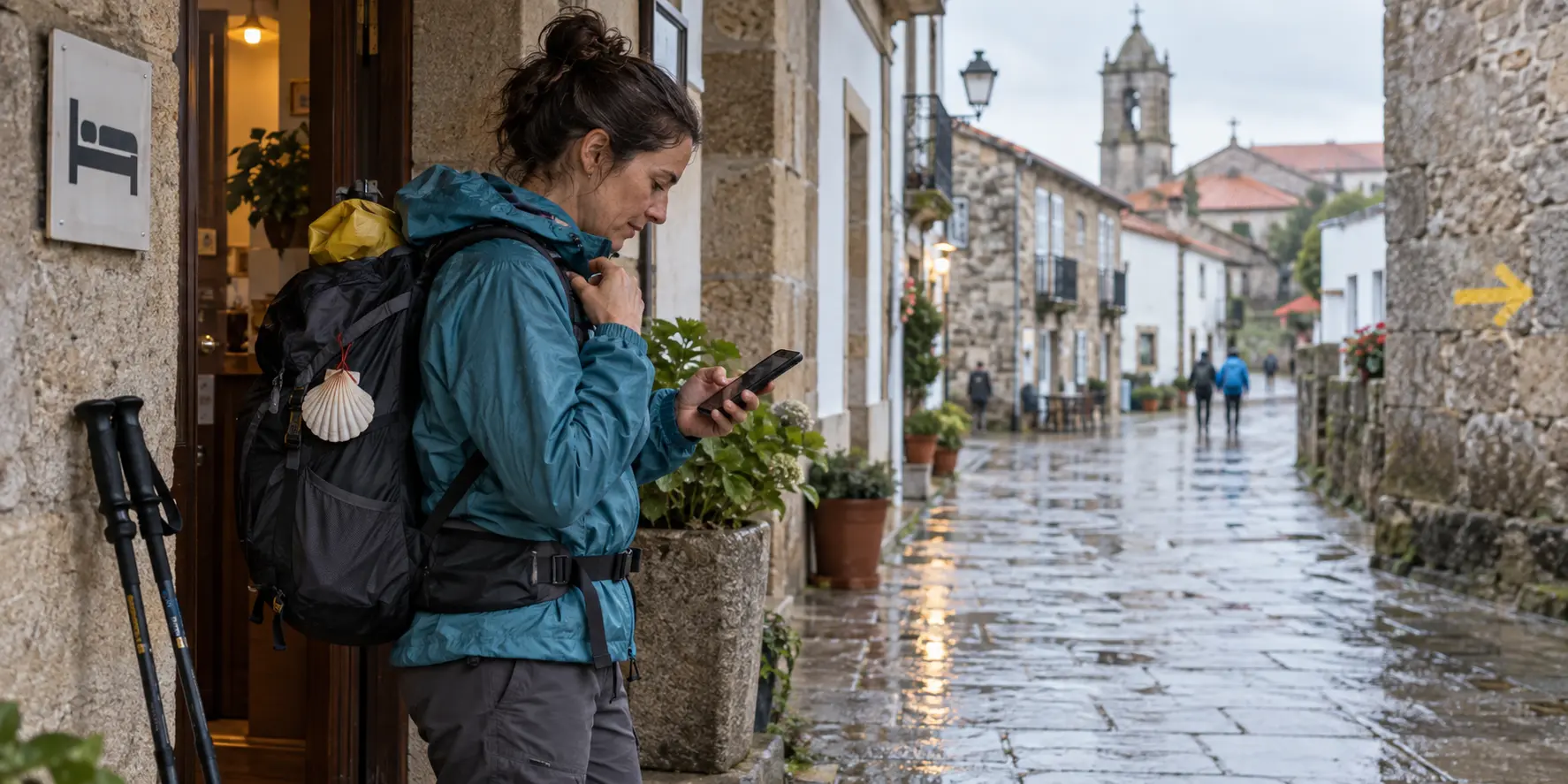
A rainy day on the Portuguese Coastal Camino does not automatically mean cancelling your walk. It does mean that the plan you made for a dry day may deserve another look before you leave your accommodation.
The practical approach is to check the current forecast and official weather warnings first, then reassess your stage length, timing, essential gear and fallback options. Rain becomes harder to manage when a long stage, a late start and a completely fixed itinerary all depend on everything going as planned.
Key takeaways
- Check official weather information shortly before walking. Use IPMA while you are in Portugal and AEMET once your route reaches Spain.
- Do not treat rain in the forecast and an official weather warning as the same planning signal. Check the actual information for the area you will walk through.
- Protect your credential, phone, dry clothing and other essential items independently rather than assuming one backpack cover will keep everything dry.
- A long fixed stage becomes more fragile when poor weather reduces your margin for delays, stops or a late departure.
- Do not assume there will always be an easy bus, train or taxi shortcut. Check realistic alternatives for that specific stage before you depend on one.
What should you check before leaving on a rainy Camino day?
Start with current information, not the weather you expected when you booked the trip.
The Portuguese Coastal Camino crosses two countries, so the official source changes as you progress. In Portugal, IPMA publishes forecasts and meteorological warnings. In Spain, AEMET provides official forecasts and weather warnings, including information for Galicia.
Check the area you are actually walking through. Weather at your destination, at your starting town and farther along the stage may not be identical.
A useful morning check looks like this:
| Check | Why it matters | Possible planning response | Do not assume |
|---|---|---|---|
| Official warnings | They tell you whether the day involves more than ordinary wet weather. | Reassess the stage and follow current official guidance. | Rain on a weather app tells the whole story. |
| Local forecast | Rain, wind and timing can change through the day. | Choose your departure time and clothing from current conditions. | One forecast applies equally to the whole route. |
| Stage length | A demanding schedule leaves less room for delays and extra stops. | Consider a shorter day if the original plan has little margin. | You need to complete the distance simply because it was booked. |
| Arrival plan | Your accommodation may have a specific check-in arrangement. | Know how you will communicate if your arrival changes. | A late arrival will automatically be straightforward. |
| Fallback options | A flexible plan is only useful if the alternative actually exists. | Identify realistic stopping or transport options before leaving. | Every stage has convenient public transport. |
Practical rule: make the decision from the conditions you have that morning, not from the itinerary you wrote several months earlier.
Does rain mean you should shorten your Camino stage?
Not necessarily.
A manageable rainy day and a day affected by more significant weather are different planning situations. There is no useful universal rule that says a pilgrim should shorten every wet stage.
The better question is how much margin your current plan gives you.
A shorter stage becomes more useful when several constraints begin to stack up: you are starting later than planned, your original stage is already long for you, daylight is more limited, your accommodation plan is inflexible, or current weather information gives you a reason to be more conservative.
By contrast, an ordinary wet day may require little more than appropriate rain protection, a realistic pace and more attention to the clock.
Do not turn the distance written in your itinerary into an obligation. Your stage plan is a planning tool, not a contract.
Why does a fixed itinerary become more fragile in poor weather?
Fixed itineraries work well when the assumptions behind them remain intact.
Suppose you have reserved a specific town, planned a relatively long walk and arranged luggage delivery there. That structure gives you less flexibility than a day where several stopping points would work.
Rain does not automatically make the fixed plan wrong. It makes the consequences of delays more important.
This is one reason to understand your wider logistics before you start. Our guide to Portuguese Coastal Camino logistics explains how accommodation, baggage and transport decisions connect across the trip.
If you decide that shortening a stage may be useful, identify the alternative before you set off. Do not rely on the idea that you will simply find transport later.
What rain gear actually matters on the walking day?
A rainy-day plan should not become a second packing list. The important question is whether your existing system protects both you and the few items that really need to stay dry.
For most pilgrims, the system has several separate jobs:
- a rain layer or poncho that works with the backpack setup you chose
- internal protection for dry clothing and other important contents
- a reliably protected phone and charging equipment
- a dry place for your Camino credential and travel documents
- something dry to change into when the walking day is finished
A backpack cover can be part of that system, but it does not have to be your only layer of protection. Internal dry bags or a waterproof liner can separate critical items from the rest of the pack.
If you are still deciding what deserves space in your backpack, use the Portuguese Coastal Camino packing list for first-time pilgrims rather than adding rain equipment item by item without considering total pack weight.
How should wet surfaces change the way you approach the stage?
Expect the walking surface to feel different after rain.
The route can include paving, stone, cobbles, compact paths and other surfaces. Their condition varies by location, maintenance and weather, so it is not useful to label an entire stage as safe or unsafe simply because rain is forecast.
The practical adjustment is simpler: do not treat your normal dry-day pace as a target. Give yourself more time, pay attention to the surface in front of you and reassess the plan if progress is slower than expected.
Also avoid building your day around an exact walking-time estimate from a guidebook or app. Those estimates cannot account for your stops, current conditions or the route choices you make that day.
How should rain change your timing and daylight plan?
Rain matters more when your schedule already has little margin.
This is particularly relevant in months with shorter daylight. A late start, a long stage and several extended stops can turn an otherwise reasonable itinerary into a rushed afternoon.
Check the forecast before deciding when to leave, but do not wait for a supposedly perfect weather window without considering the rest of the day.
The useful questions are:
- How much walking do I realistically have ahead?
- Am I starting later than planned?
- Do I know where I can stop if I decide not to complete the original stage?
- Does my accommodation require any arrival coordination?
- Am I leaving enough margin rather than relying on an exact walking-time estimate?
If you are still choosing when to walk, weather should be considered as a seasonal tradeoff rather than a promise. The best time to walk the Portuguese Coastal Camino guide compares rain, daylight and other planning factors across the year.
When should you reconsider the original plan?
No article can decide whether a specific stage is appropriate under the conditions you will encounter. Current official information and what you actually see on the ground matter more than a generic Camino rule.
However, there are useful triggers for reassessing the day:
- an official weather warning affects the area you intend to walk through
- official or local information indicates a route closure or temporary problem
- your start has been delayed enough to remove the margin in the original plan
- the conditions are materially different from those you planned for
- you no longer have a realistic way to reach your booked destination on the original schedule
Reassessing does not automatically mean stopping. It means making a new decision from current information instead of continuing only because the original itinerary says so.
Rainy-day checklist for the Portuguese Coastal Camino
- Check the current local forecast.
- Check official warnings from IPMA in Portugal or AEMET in Spain.
- Confirm the distance and basic shape of the stage you intend to walk.
- Check whether the original stage still leaves a reasonable time margin.
- Protect your credential, phone, electronics and dry clothing.
- Make sure your rain layer is accessible before leaving, not buried at the bottom of the backpack.
- Know your accommodation arrangements at the destination.
- Identify any realistic shorter stopping point or transport alternative before you need it.
- Recheck the plan during the day if conditions or your progress differ materially from what you expected.
FAQ
Can you walk the Portuguese Coastal Camino in the rain?
Rain alone does not produce a universal yes or no answer. Many Camino days include wet weather. What matters is the current forecast, official warnings, the stage you have planned, your equipment and the conditions you encounter. Reassess the day rather than treating all rain as equivalent.
Where should I check official weather warnings?
Use IPMA for the Portuguese section of the route and AEMET for Spain and Galicia. Check current information for the area you are actually walking through rather than relying only on a general weather app.
Is a backpack rain cover enough?
It can be one part of your system, but important items are easier to protect if they have their own internal waterproof protection. Your phone, credential, travel documents, electronics and dry clothing should not all depend on one outer cover working perfectly.
Should I book a shorter stage when rain is forecast?
Not automatically. First look at how demanding your original stage is, the current weather information, daylight, your departure time and how much flexibility you have. A shorter stage can be useful when several constraints are already reducing your margin.
Can I rely on public transport if I decide to stop early?
Do not assume so. Transport options vary substantially by location and time. If shortening the stage is part of your fallback plan, check the current option for that specific section before depending on it.
Your next step before a wet Camino day
Before leaving your accommodation, make four decisions: check the official weather information, decide whether the original stage still makes sense, protect the items that cannot get wet and identify what you will do if the day takes longer than expected.
If those four points are clear, rain becomes part of the day’s planning rather than a reason to improvise the entire stage after you have already started walking.