Portuguese Coastal Camino blisters are easier to deal with before they become a walking problem. The practical priorities are straightforward: use footwear that fits properly, test your shoes and socks before Porto, manage friction and moisture, and pay attention when an area starts to rub or feel uncomfortable.
None of these steps can guarantee a blister-free Camino. Feet, footwear, weather and walking patterns differ between pilgrims. The goal is to reduce avoidable problems and notice warning signs early rather than search for one supposedly perfect product or technique.
Key takeaways
- Do not save new shoes, socks or insoles for the Camino. Test the combination you intend to use on substantial training walks.
- Both friction and moisture can contribute to foot blisters, so shoe fit and sock choice matter together.
- If your socks become wet or very damp, changing into a dry pair can reduce one source of irritation.
- Treat a developing hot spot as useful information. Stop, check what is rubbing and protect the area rather than automatically walking through it.
- No sock, tape, lubricant or shoe prevents blisters for everyone. Test anything you plan to rely on before departure.
- If a blister appears infected or the problem goes beyond simple friction discomfort, general Camino advice is no longer enough. Seek appropriate medical care.
Why do pilgrims develop blisters?
For walkers, blisters commonly develop where repeated rubbing affects the skin. Shoes that move against the heel, toes rubbing inside the toe box, sock seams and areas of repeated pressure can all create friction.
Moisture adds another variable. Sweat, rain or wet footwear can leave the skin and socks damp for long periods. That does not mean every wet foot will blister, but keeping socks reasonably dry and limiting unnecessary rubbing are sensible prevention measures.
This is why blister prevention is less about finding a special Camino product and more about understanding the complete system around your feet: shoe fit, socks, moisture, walking duration and the places where you personally tend to rub.
Test your footwear before you leave for the Camino
The first walking day should not be the first serious test of your shoes.
Use your planned Camino footwear on longer training walks and, when your preparation allows it, on consecutive walking days. A short walk around the neighbourhood may tell you whether a shoe feels obviously uncomfortable. Several hours on your feet reveal much more about heel movement, toe pressure, sock seams and other friction points.
The key question is not whether a shoe is labelled as a hiking boot, trail runner or walking shoe. It is whether it fits your feet well and remains comfortable during the type of walking you are preparing to do.
New footwear should also have enough real walking time before departure for you to discover fit problems. That is different from assuming that every shoe requires a fixed number of kilometres to be “broken in”. There is no useful universal mileage target.
If you are still building your preparation, our Portuguese Coastal Camino training plan explains how longer walks and consecutive walking days can double as realistic equipment tests.
Choose socks as part of the footwear system
Socks should not be treated as an afterthought. Clinical blister-prevention guidance commonly recommends moisture-wicking socks for activities that involve prolonged walking, while also emphasising proper shoe fit.
That still leaves room for personal preference. Some pilgrims prefer one pair of hiking socks. Others find a liner-and-outer-sock combination more comfortable. Neither approach is automatically better for every foot.
Test the exact combination you plan to wear. Pay attention to bunching, seams, slipping and whether your feet become excessively damp during longer walks.
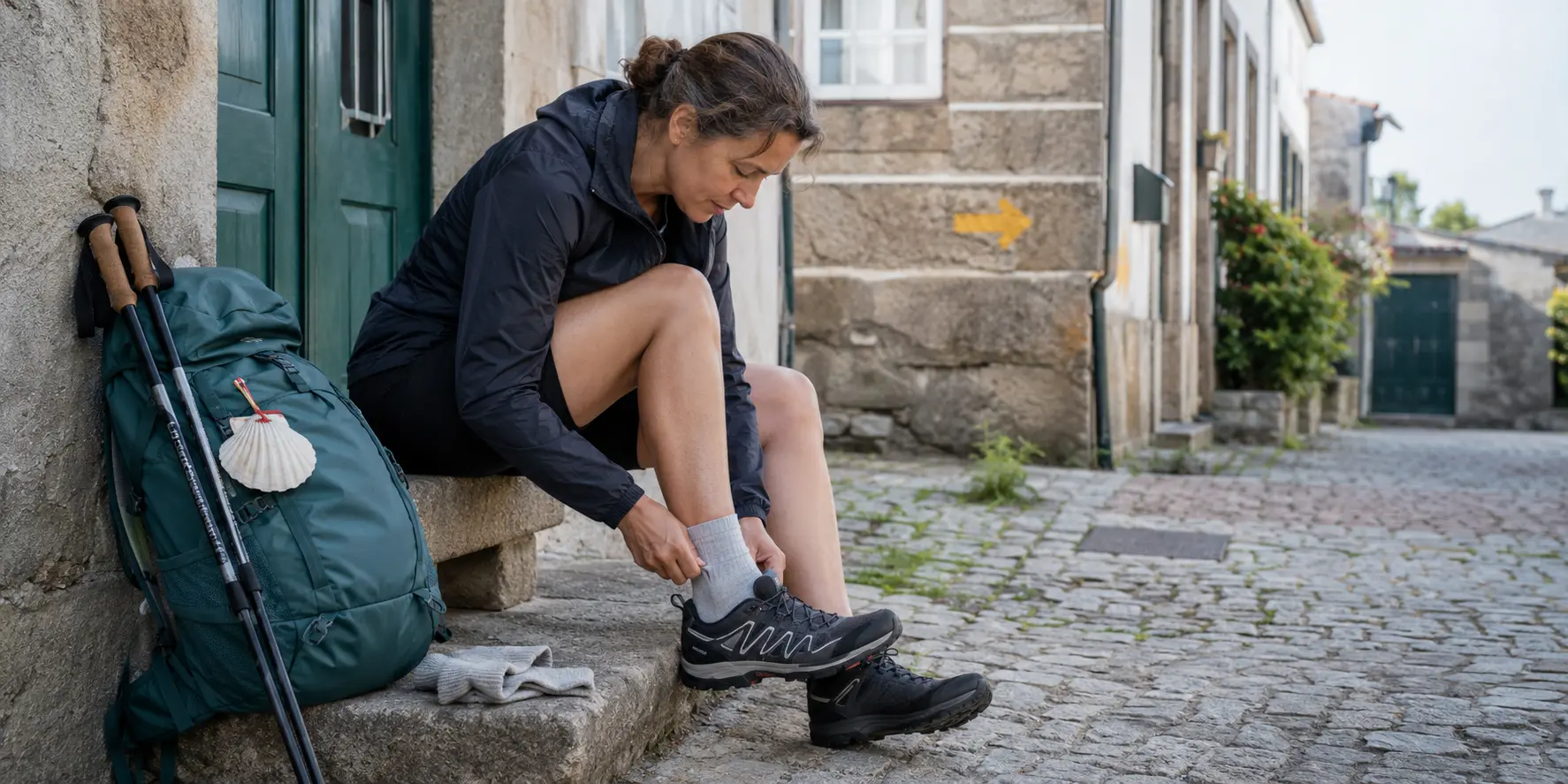
Carrying a spare dry pair is a simple option. If your walking socks become soaked by rain or noticeably damp during the day, you can change them rather than keep the same wet layer against your skin for the rest of the stage.
What should you do when you notice a hot spot?
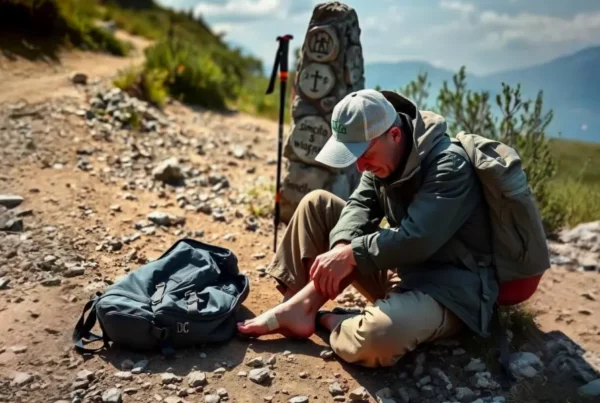
A hot spot is an early area of irritation that may feel warm, tender or as though something is repeatedly rubbing. Do not treat it as an inconvenience that has to wait until the next café or accommodation.
Stop and check what is happening. A sock may have folded. Grit may have entered the shoe. A lace adjustment may change how the foot moves. Your sock may simply be wet.
Once you have addressed the obvious cause, protecting a friction-prone area with an appropriate soft dressing, blister bandage or tape can be useful. Dermatology and first-aid guidance both support protecting areas where rubbing is developing.
The important distinction is between protection and experimentation. The middle of a Camino stage is a poor place to discover that a new tape, adhesive or foot product irritates your skin. Test your planned approach during preparation where practical.
Do anti-blister balms, petroleum jelly, powder or tape work?
There is no single answer that applies to every pilgrim.
Some established dermatology guidance includes petroleum jelly or powder among options for reducing friction or moisture in problem areas. Protective tape, moleskin and blister dressings are also commonly recommended for friction-prone skin.
That does not make any particular brand or technique universally necessary. Different feet respond differently, and an intervention that works well for one walker may be uncomfortable or unnecessary for another.
The practical rule is to test rather than assume. If you intend to use a lubricant, powder, tape, liner sock or specialist blister product on the Camino, include it in at least one meaningful training walk first.
A practical blister-prevention routine for a walking day
| When | What to check | Practical action | Why it matters |
|---|---|---|---|
| Before walking | Shoes, socks and known friction points | Use the footwear and sock setup you have already tested | Avoids introducing an unnecessary new variable at the start of the day |
| During an early break | Rubbing, dampness or sock movement | Adjust the cause before discomfort becomes more pronounced | Small fit problems often become more noticeable after time on your feet |
| After rain or heavy sweating | Wet or very damp socks | Change into a dry pair when practical | Reduces prolonged moisture inside the shoe |
| At the first hot spot | Exact location and likely source of friction | Stop, inspect, adjust and protect the area if appropriate | Early irritation is more useful to act on than to ignore |
| After the stage | Areas that repeatedly rubbed during the day | Use what you learned to adjust the next day's setup | Camino foot care is an ongoing equipment and pacing check |
Build foot testing into your Camino preparation
You do not need to recreate the full Porto-to-Santiago walk before departure. You do need enough experience with your planned setup to know how it behaves after more than a short test.
Longer training walks can answer practical questions that shopping research cannot:
- Does your heel move inside the shoe after several hours?
- Do your toes have enough room when your feet have been in the shoes for a long time?
- Do your socks bunch or develop uncomfortable seams?
- Where do you repeatedly notice rubbing?
- Does the same footwear still feel sensible when you walk again the following day?
Use these sessions to refine the setup before departure, not to chase an arbitrary training distance.
What should you pack for basic blister prevention?
You do not need an oversized foot-care kit. You need a small set of items that you understand how to use.
- A spare pair of walking socks.
- Your chosen protective tape, soft dressing or blister bandage if you have tested it.
- A small amount of any friction-reduction product you already know works for you, if you use one.
- Your normal basic hygiene supplies.
Avoid packing several competing blister systems simply because other pilgrims recommend them. More products create more decisions without necessarily creating better prevention.
For the rest of your walking equipment, use our Camino de Santiago packing list for the Portuguese Way as a broader preparation check.
Should you keep walking if you develop a blister?
A general travel article cannot tell you whether it is medically appropriate for you to continue walking with a particular blister, wound or level of pain.
Minor friction problems and serious skin problems should not be treated as the same thing. If a blister becomes increasingly painful, appears infected, produces pus, feels unusually warm, or develops spreading skin changes around it, seek appropriate medical care rather than relying on blog advice.
The same applies if you have a medical condition that affects healing, circulation or foot health. Individual medical guidance takes priority over generic Camino advice.
Common blister-prevention mistakes first-time pilgrims can avoid
Buying new shoes just before departure
A technically suitable shoe can still be the wrong fit for your foot. Leave enough time to walk properly in your planned Camino footwear before you travel.
Testing shoes but not the socks
Your shoe and sock combination matters. A comfortable shoe can feel different with thicker socks, a liner or a seam that sits in the wrong place.
Ignoring a hot spot until the end of the stage
Early rubbing gives you information. Stop and investigate why it is happening rather than treating discomfort as something you automatically have to push through.
Assuming one product guarantees prevention
Tape, powders, lubricants and specialist socks can all have a place, but no single option eliminates blister risk for every walker.
Changing several things at once
If you change shoes, socks, insoles and foot products immediately before the Camino, it becomes harder to identify which part of the setup is helping or causing irritation.
FAQ
Can you completely prevent blisters on the Camino?
No method can guarantee that you will not develop a blister. Good shoe fit, tested socks, friction management, dry socks when practical and early attention to rubbing can reduce avoidable risk.
Are hiking boots better than trail runners for preventing blisters?
Not universally. Blister risk depends more on how the footwear fits and interacts with your feet and socks than on whether it belongs to one footwear category. Test the type you intend to use on realistic walks.
Should I avoid cotton socks?
Clinical blister-prevention guidance generally favours moisture-wicking socks for prolonged physical activity. What matters on the Camino is that your sock setup fits properly, manages moisture reasonably well and has been tested with your footwear.
Should I wear two pairs of socks?
Some blister-prevention guidance suggests that two layers may help some people, but it is not a universal requirement. If you want to use a liner-and-outer-sock system, test it first and make sure the extra volume does not make your shoes too tight.
Should I pop a blister?
This guide deliberately does not provide invasive blister-treatment instructions. If you develop a blister, protect it from further friction and use appropriate medical or first-aid advice for your situation. Seek professional care if you are concerned about infection, worsening symptoms or whether it is appropriate to continue walking.
Your next step before the Camino
Do one useful footwear test before you buy another blister product.
Wear the shoes, socks and insoles you expect to use on the Camino for a substantial walk. Notice where your feet become damp, where anything rubs and how the setup feels after several hours.
Then repeat the test on another day if your preparation allows it. The aim is not to prove that you can walk a particular distance. It is to arrive in Portugal already knowing how your own footwear system behaves.