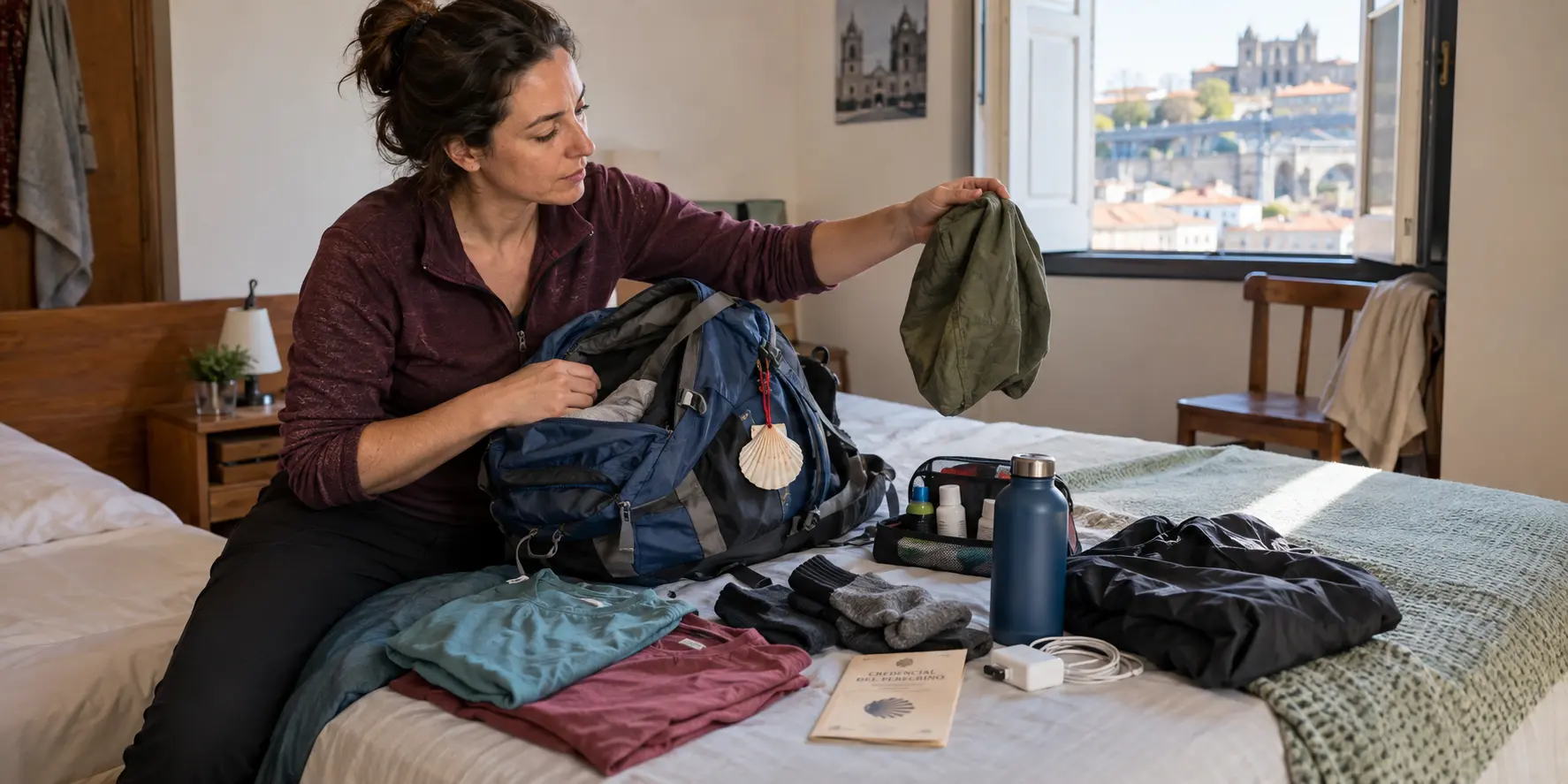
A useful Portuguese Coastal Camino packing list should match the trip you are actually planning. A pilgrim carrying everything from Porto to Santiago needs a different setup from someone using baggage transfer. A June walk does not need the same clothing as late October, and an albergue itinerary creates different overnight needs from a trip built around private rooms.
The practical goal is not to reach a perfect target weight or copy somebody else’s gear list. It is to carry what you expect to use, remove unnecessary duplication and test the complete setup before you leave.
Key takeaways
- Decide whether you will carry your full backpack or use baggage transfer before you finalise the rest of your packing list.
- Do not use a universal percentage of body weight as the only test of whether your backpack is sensible. Test the load you actually expect to carry.
- Pack clothing as a small layering system rather than one outfit for every walking day.
- Keep rain protection available even in a generally drier walking month. Climate averages do not predict the weather on your particular Camino.
- Choose footwear that you have already tested for several hours with your Camino setup rather than assuming one type of shoe is best for everyone.
- Check what your accommodation provides before packing a sleeping bag, liner, towel or other hostel-specific equipment.
- Keep your passport or ID, pilgrim credential, payment methods, phone and essential daily items with you rather than in transferred luggage.
Start with four decisions before you pack anything
The easiest way to overpack is to start with a long shopping list. Start with the structure of the trip instead.
- Decide whether you will carry all your luggage or use baggage transfer.
- Confirm the month and likely weather range for your dates.
- Decide whether you expect to stay mainly in albergues, private rooms or a mixture.
- Look at your real stage plan and identify what you genuinely need access to while walking.
Those four decisions remove a surprising amount of uncertainty. They tell you how large your walking pack needs to be, how much clothing makes sense, whether sleeping gear belongs on the list and which items must stay with you during the day.
Portuguese Coastal Camino packing checklist
| Category | Pack | Adjust for | Common excess |
|---|---|---|---|
| Walking clothing | A small rotation of tops, bottoms, underwear and walking socks | Season, laundry rhythm and drying conditions | An outfit for every day |
| Weather | Rain protection, an insulating layer when appropriate and sun protection | Month, forecast and stage length | Bulky backup layers for unlikely conditions |
| Footwear | Tested walking shoes and comfortable socks | Fit, terrain preference and weather | Multiple heavy spare shoes |
| Accommodation | Only the sleep, shower and laundry items your accommodation strategy requires | Albergues versus private rooms | Assuming every property provides the same equipment |
| Daily essentials | Water capacity, phone, credential, ID, payment methods and essential personal items | Your stage and expected services | Moving essential items into transferred luggage |
| Electronics and toiletries | Phone, charger, necessary cables and small toiletries | Travel before and after the Camino | Duplicate gadgets and full-size containers |
How much should you carry?
There is no backpack percentage that works for every pilgrim. Body size, backpack fit, the type of equipment you need, your walking experience and whether you use baggage transfer all change the answer.
A better test is practical. Assemble the real kit, add the water and daily items you expect to carry, then walk with it for several hours. If you repeatedly want to remove the pack, struggle with its fit or discover that half its contents never have a clear purpose, adjust the setup before departure.
The same principle applies to backpack capacity. More space can make packing at home easier, but it can also make unnecessary items harder to reject. Our guide to choosing a backpack for the Portuguese Coastal Camino looks at that decision in more detail.
What clothing do you actually need?
Think in layers and laundry cycles rather than walking days.
For many Camino plans, a small clothing rotation is more useful than carrying clean clothes for every day. Your exact quantities depend on how often you are willing to wash clothes, how quickly your clothing dries and whether you want separate clothes for evenings.
A practical starting structure is:
- two or three walking tops
- two walking bottoms, or one main pair plus a lighter alternative
- a small rotation of underwear
- several pairs of walking socks so that you are not dependent on one pair drying overnight
- one light insulating layer appropriate to your season
- one rain layer
- simple clothes for evenings only if your walking clothes do not already cover that need
Do not treat those quantities as rules. Someone walking in warm weather with a disciplined laundry routine may carry less. Someone walking in cooler months may need more flexibility.
How should the season change your packing list?
The Portuguese Coastal Camino crosses northern Portugal and continues into Galicia, so packing only for the weather you expect in Porto is too narrow.
Official climate data around Porto show a much drier summer pattern than the wetter months from autumn into winter. That is useful for planning, but it is not a forecast. Rain can still occur during a summer Camino, while spring or autumn can include warm and dry periods.
The practical approach is to choose the basic system months in advance, then make the final clothing decision from the forecast shortly before departure.
Late spring and summer
Prioritise lightweight clothing that works across warm walking hours, plus sun protection and a rain system that does not take over the backpack. Avoid assuming that a generally drier month means rain protection has no value.
Early autumn
Keep the lightweight walking setup but allow more flexibility for cooler mornings, rain and wind. A layer that works during an early start can usually earn its place more easily than several specialised cold-weather items.
Late autumn and winter
This is a different packing decision. Cooler conditions, wetter weather and shorter daylight can justify warmer layers and more substantial weather protection. Check accommodation and other seasonal services as part of the same planning process.
If you have not chosen your walking month yet, compare the seasonal tradeoffs in our guide to the best time to walk the Portuguese Coastal Camino.
What footwear should you pack for the Portuguese Coastal Camino?
Do not choose footwear from a rule that says every Camino requires hiking boots, trail runners or another specific category.
The more useful question is whether the footwear fits properly, works with your socks, feels comfortable after several hours and suits the conditions in which you expect to walk.
Whatever you choose, test the exact shoes and socks before departure. Use them on longer walks and, if possible, on consecutive walking days. The first stage from Porto is a poor place to discover that your planned footwear does not work for you.
You may also want lightweight footwear for accommodation, showers or evenings. That is useful when it solves a real second purpose. A second substantial pair of walking shoes is harder to justify unless you know why you need it.
What rain gear should you bring?
Rain protection deserves a deliberate decision rather than a last-minute emergency purchase.
Your system may be a waterproof jacket, poncho or another setup that you have tested. The important point is that you know how it works with your backpack or daypack before you need it.
Also protect the items for which getting wet creates a real problem. Your passport or ID, credential, phone and other important documents should have a simple waterproof system even if the rest of the pack uses a cover or waterproof liner.
Do not assume that one rain solution keeps every part of your equipment dry in every condition. Test it at home or during a wet training walk.
What do you need for albergues and accommodation?
Accommodation style changes the packing list more than many first-time pilgrims expect.
If you plan to stay mainly in albergues or hostel-style accommodation, check individual properties for bedding, towel and other overnight arrangements. Do not assume that every pilgrim accommodation provides the same things.
Depending on the accommodation you book, useful items may include:
- a compact towel
- a sleeping liner or sleeping bag when the accommodation and season make one useful
- shower footwear
- earplugs and an eye mask for shared rooms
- a small laundry bag
- small quantities of detergent if you plan to wash clothes yourself
If you mainly book private rooms that provide bedding and towels, part of that list may disappear. Check first rather than carrying hostel equipment for a trip that does not need it.
Which documents and valuables should stay with you?
Keep the important documents and valuables together in a simple system that you can access without unpacking the entire bag.
- passport or the travel identification appropriate to your trip
- pilgrim credential if you are using one
- bank cards and some access to cash
- phone
- travel confirmations you genuinely need during the day
- any essential personal items that you cannot afford to have separated from you
If you are collecting stamps and plan to request the Compostela, review our Camino credential and stamps guide before departure rather than treating the credential as an optional piece of paper at the bottom of the backpack.
What electronics should you carry?
For most first-time pilgrims, the phone already covers navigation, communication, bookings, photography and entertainment. The electronics problem is usually duplication rather than omission.
A simple setup may include:
- your phone
- one charger
- the cables your actual devices require
- a plug adapter if your home plugs are incompatible with those used in Portugal and Spain
- a power bank only if your normal phone use and charging opportunities make one useful
Do not pack backup electronics simply because they are small. Chargers, cables, batteries, cameras, watches and other devices add up quickly.
How should baggage transfer change what you pack?
Baggage transfer changes where your equipment travels. It does not make every item necessary.
If your main bag moves between accommodations, your walking pack still needs to work as an independent daypack. Keep what you may need before reaching the next accommodation with you.
- water and any food you plan to carry
- rain protection
- the layer you may need during the stage
- passport or ID and pilgrim credential
- phone and payment methods
- essential personal items
Your transferred bag can hold spare clothing, overnight items and other equipment that you do not need while walking.
Do not build the packing system before you know whether the luggage service fits your actual route and accommodation plan. Provider coverage, operating periods, baggage limits and accommodation requirements can change. Compare the current options in our guide to baggage transfer from Porto on the Portuguese Coastal Camino and confirm the details before paying.
Do you need trekking poles?
No single packing list needs to treat trekking poles as compulsory.
They can be useful if you already prefer walking with them, expect to use them on uneven sections, carry your full pack or simply feel more comfortable with the additional support. They are less useful if they spend most of the trip attached to your backpack.
If you are undecided, test them before departure with the footwear and pack you intend to use. Our guide to walking sticks on the Portuguese Coastal Camino explains the tradeoff in more detail.
What should you leave at home?
Most overpacking happens one reasonable item at a time. Very few pilgrims deliberately pack something obviously ridiculous. They pack several things that each sound useful in isolation.
Question these categories first:
- clothes for every possible version of the trip
- multiple heavy pairs of footwear
- full-size toiletries
- large quantities of food for stages where you have not established a need for them
- duplicate chargers, batteries and electronics
- books or entertainment already available on your phone
- specialised equipment you have never used during training
- a large sleeping system without first checking your accommodation
- extra backpack capacity added mainly for items you might use
A useful test is simple: explain when, where and how you expect to use each item. If the answer is only “just in case”, decide whether the problem can realistically be solved along the route instead.
Do not guess your water requirement from another pilgrim's list
Your water carrying capacity should match your stage plan, weather and expected opportunities to refill.
A fixed quantity copied from somebody else’s packing list can be too much for one stage and not enough for another. Check the day’s route and services rather than assuming that water will appear at a fixed distance.
This is particularly important on warmer days or when your route variation takes you away from the places where you expected to stop.
Run a full packing test before you fly
The final test should happen before departure, not on the floor of your Porto accommodation.
- Pack everything you intend to take.
- Add the water and daily items you expect to carry.
- Wear the shoes and socks you plan to use.
- Walk for several hours with the actual backpack or daypack.
- Use your rain setup if you get the opportunity.
- Check which items were difficult to access.
- Remove duplicates and items without a clear purpose.
- Repeat the test if the final load changes significantly.
You do not need to reproduce an entire Camino stage. The purpose is to discover obvious equipment problems while they are still easy to fix.
FAQ
How heavy should my backpack be on the Portuguese Coastal Camino?
There is no universal percentage that works for every pilgrim. Build the lightest practical setup for your trip, then test that real load during longer walks. Backpack fit, season, accommodation and whether you use baggage transfer all matter.
How many clothes should I pack?
Pack around a laundry rhythm rather than the number of Camino days. A small rotation of walking clothes is usually more practical than carrying a separate outfit for every stage. Add clothing only when your season or accommodation strategy creates a clear reason.
Do I need a sleeping bag?
That depends on the season and the accommodation you plan to use. Bedding arrangements vary, so check your booked or likely accommodation rather than assuming every albergue follows the same system.
Do I need waterproof hiking boots?
No single footwear type is right for every pilgrim. Fit, comfort after several hours and experience with the footwear are more useful decision criteria than choosing a shoe because it appears on a generic Camino list.
Can I walk with only a daypack?
Yes, if your main luggage is transferred between accommodations and the service works with your itinerary. Your daypack still needs to carry everything you may require during the walking stage.
Should I pack trekking poles?
Only if they fit the way you expect to walk. Test them before the Camino rather than assuming that every pilgrim needs them.
Your final packing check
Before closing the backpack, ask three questions about every item: will I realistically use it, does something else already solve the same problem, and do I need access to it while walking?
Then check the complete setup against your month, accommodation and luggage strategy. Those decisions matter more than copying an exact weight or somebody else’s list.
If you still have too much equipment, solve the largest decision first: whether you are carrying everything yourself or using baggage transfer. Once that is clear, the rest of the Portuguese Coastal Camino packing list becomes much easier to simplify.