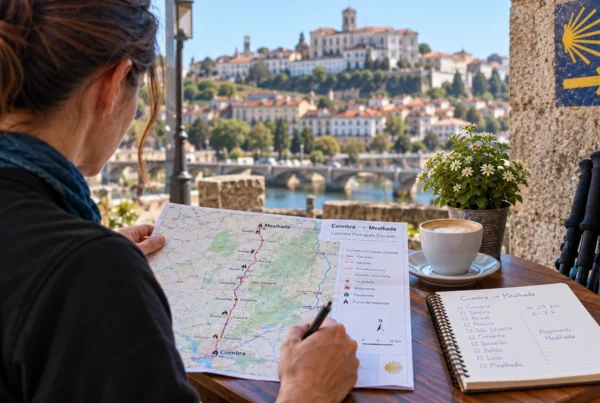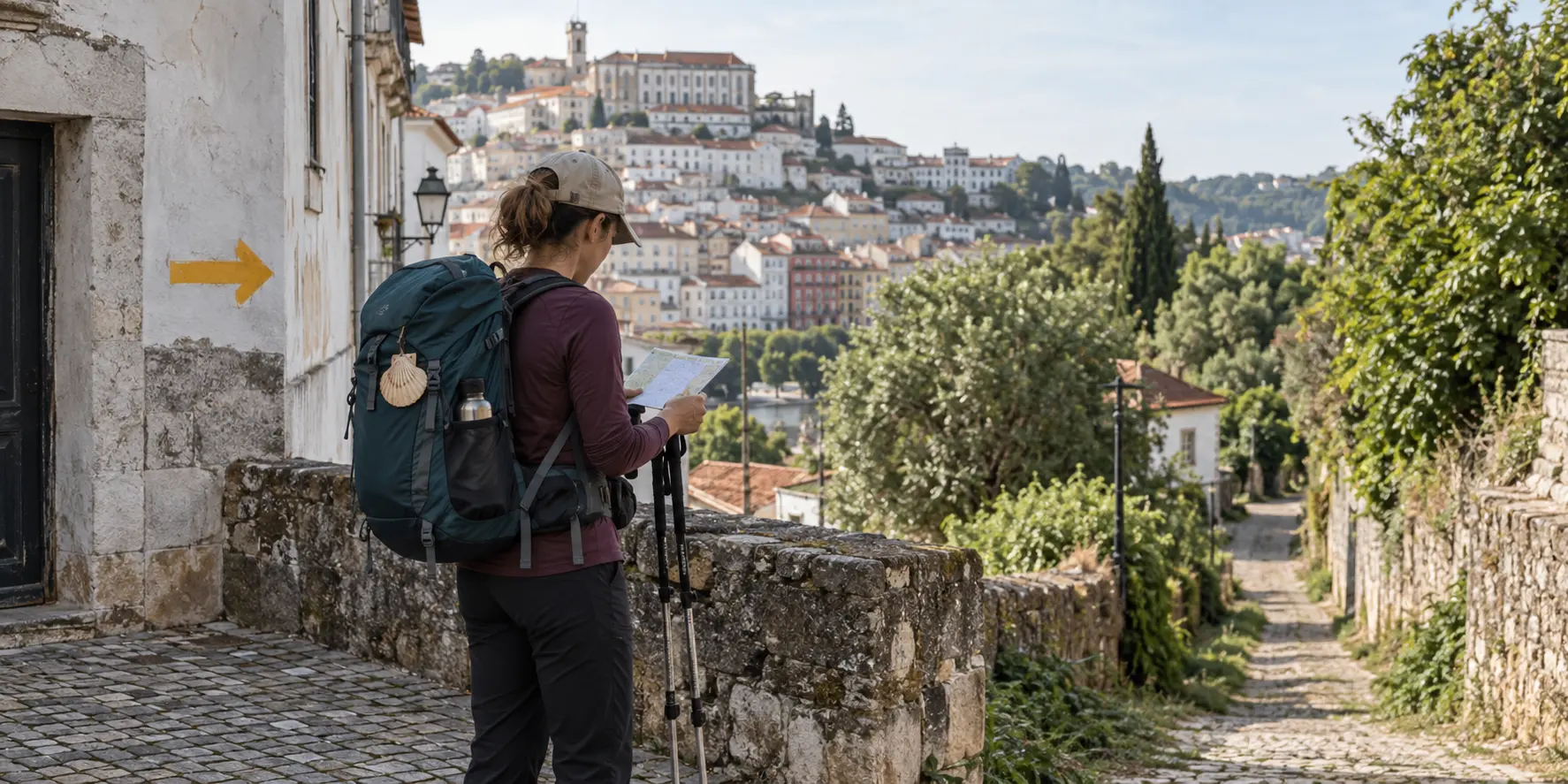
The Portuguese Camino from Coimbra to Porto follows the Portuguese Camino Central, not the Coastal Camino. Using Turismo de Portugal’s reference segmentation, the section is approximately 154 km and divided into six walking stages. That does not mean every first-time pilgrim should copy those six days exactly.
The better planning question is whether you want a compact six-day walk to Porto or a more flexible itinerary that avoids relying on the longest reference stages. Once you reach Porto, you can then decide whether to continue on the Central Route or switch to the Portuguese Coastal Camino.
Key takeaways
- Coimbra to Porto is part of the Portuguese Camino Central. The Coastal Camino becomes an onward route choice in Porto.
- Turismo de Portugal’s reference stages total approximately 153.5 km, which is best treated as roughly 154 km rather than an exact universal distance.
- The official reference sequence uses six walking days, but two stages are listed above 30 km. You do not need to follow that segmentation.
- Current Portuguese route sources measure some of the same sections differently and also use different stage endpoints, so your stage plan matters more than one headline distance.
- Coimbra can work well as a starting point if you want several extra days before Porto and are prepared to plan the Central Route rather than expecting the same stage pattern as the Coastal Camino.
Is Coimbra a sensible place to start the Portuguese Camino?
It can be. Coimbra makes sense if Porto feels too short for the Camino you want but starting much farther south would add more days than you have available.
Starting here gives you a substantial Central Route section before Porto. Using the Turismo de Portugal reference plan, you have six walking stages before reaching the Douro.
The main tradeoff is that you need to think more carefully about stage design. The official reference list includes days of approximately 31 km and 33.5 km, while current route platforms sometimes measure or divide those sections differently.
That makes Coimbra a better fit for someone willing to plan distances and overnight stops deliberately. If your priority is the simplest possible start directly onto the Coastal route, Porto remains the clearer starting point.
Which Camino route runs from Coimbra to Porto?
Coimbra to Porto is on the Portuguese Camino Central, also called the Caminho Português Central.
Turismo de Portugal describes the Central Route as passing through Lisbon, Coimbra and Porto and continuing north toward Santiago. It is also described as waymarked from Lisbon with the familiar yellow Camino arrows.
This distinction matters for Pilgrims of the Coast readers because the route identity changes the planning context. You are not walking the Portuguese Coastal Camino between Coimbra and Porto.
Porto is the transition point where a pilgrim who wants to continue along the coast can deliberately choose the Portuguese Coastal Camino stages from Porto.
How far is the Portuguese Camino from Coimbra to Porto?
Using the six Coimbra-to-Porto stages currently published by Turismo de Portugal gives a total of approximately 153.5 km.
For planning, call that roughly 154 km.
| Reference stage | Turismo de Portugal distance | Planning note |
|---|---|---|
| Coimbra → Mealhada | 23 km | A relatively conventional first walking day. |
| Mealhada → Águeda | 31 km | Long enough to deserve a current route-distance check. |
| Águeda → Albergaria-a-Velha | 19.5 km | A shorter reference day between longer sections. |
| Albergaria-a-Velha → Oliveira de Azeméis | 23 km | A moderate reference distance. |
| Oliveira de Azeméis → Grijó | 33.5 km | The clearest stage where an alternative split deserves consideration. |
| Grijó → Porto | 23.5 km | The final reference day before reaching Porto. |
These figures are useful as a common baseline. They should not be treated as six mandatory stage lengths.
Why do Coimbra-to-Porto Camino distances differ between sources?
The differences are large enough that it is worth understanding them before booking accommodation.
For example, Turismo de Portugal gives approximately 31 km for Mealhada to Águeda. The current Caminhos da Fé route information gives the same endpoints as approximately 25 km.
The same pattern appears elsewhere. Turismo de Portugal gives 19.5 km from Águeda to Albergaria-a-Velha, while current Caminhos da Fé mapping gives 15.9 km.
This does not make the route unusable. It means a stage distance is partly a product of the exact route track, start and finish points, mapping method and route information being used.
Practical rule: use the Turismo de Portugal sequence to understand the overall journey, but check a current route file before you decide that a specific walking day will be exactly 19, 25 or 31 km.
How many walking days should you allow from Coimbra to Porto?
The official reference sequence gives you a simple answer: six walking days.
That can work if the stage lengths suit you. It should not automatically become your itinerary simply because it appears on an official tourism page.
| Plan | Best for | Main tradeoff |
|---|---|---|
| 6 walking days | Pilgrims comfortable with longer stages and the reference structure | Some published reference distances exceed 30 km. |
| 7 walking days | Pilgrims who want more flexibility around the longest sections | You need to verify an additional overnight stop that fits the current route. |
| 8 walking days | First-time pilgrims who prefer shorter days or more recovery time | More accommodation nights and more stage-planning decisions. |
The right number depends less on whether six days is possible and more on how you want consecutive walking days to feel.
If a 30 km day already sounds uncomfortable before the trip starts, use that as useful planning information. Do not assume that you need to reproduce an official stage list to walk the Camino correctly.
Where does the official six-stage plan become less useful?
Two parts deserve extra attention.
Mealhada to Águeda
Turismo de Portugal lists this at approximately 31 km, but current Caminhos da Fé route data gives about 25 km between the same named endpoints.
That is too large a difference to hide behind false precision. Before deciding to split this day, first check the current route track you intend to follow.
A 25 km walking day and a 31 km walking day create very different planning decisions for a first-time pilgrim.
Oliveira de Azeméis towards Grijó
The older reference sequence groups Oliveira de Azeméis to Grijó into one 33.5 km stage.
Current regional Camino information uses different stage endpoints farther north. Caminhos da Fé, for example, treats São João da Madeira and Santa Maria da Feira as stage destinations in this section rather than requiring a single Oliveira de Azeméis to Grijó day.
That is the more important lesson than choosing one supposedly perfect alternative: 33.5 km is a reference stage, not a requirement.
If you would rather walk shorter days, build this section around verified accommodation and the current route instead of forcing yourself to reach Grijó because an older stage table does.
What kind of walking should you expect between Coimbra and Porto?
This is not a coastal walking route. Expect a mixture of urban exits, rural sections, cultivated landscapes, woodland and paved roads.
Current Caminhos da Fé information describes the Coimbra to Mealhada, Mealhada to Águeda and Águeda to Albergaria-a-Velha sections as combinations of earth and asphalt.
Farther north, the character becomes increasingly urban in places. Current route information for Oliveira de Azeméis towards São João da Madeira and Santa Maria da Feira describes substantial asphalt and urban walking.
That means footwear decisions should not be based on an image of continuous forest trails. You are walking a historic pilgrimage corridor through populated central and northern Portugal, with surfaces that change throughout the route.
Should you book every night before leaving Coimbra?
You do not necessarily need to lock every stage months ahead simply because you are starting in Coimbra.
You do need to verify that every planned stage endpoint works as an overnight stop before you commit to the itinerary.
This is especially important when you move away from the six reference endpoints. An intermediate town that looks ideal on a distance chart is only useful if the overnight logistics also make sense.
Before using an alternative split, confirm:
- that it is actually on or sensibly accessible from your current route
- that there is accommodation you are willing to use
- that the following day still creates a reasonable distance
- that food and water assumptions do not depend on one unverified business
- that luggage transfer, if relevant to your trip, works with the chosen stop
The accommodation decision should validate the stage plan, not come after it.
How should a first-time pilgrim build the itinerary?
Start with the six reference sections, then challenge the parts that look fragile.
- Use Coimbra → Mealhada → Águeda → Albergaria-a-Velha → Oliveira de Azeméis → Grijó → Porto as the reference sequence.
- Check current route distances rather than relying only on the older approximate numbers.
- Identify any day that exceeds the distance you actually want to walk.
- Find a verified intermediate stop only where it improves the overall sequence.
- Check how that new stop changes the following day.
- Book accommodation only after the stage sequence works from beginning to end.
This avoids one of the easiest Camino planning mistakes: solving one long day by creating a worse day immediately afterwards.
Is Coimbra better than Porto as a Camino starting point?
Neither is universally better.
| Start in Coimbra if... | Start in Porto if... |
|---|---|
| You want roughly another week of walking before Porto. | You have fewer walking days available. |
| You want to include part of the Portuguese Camino Central. | Your main objective is the Coastal Camino itself. |
| You are comfortable designing stage splits rather than copying one fixed itinerary. | You want a simpler transition into established Porto-to-Santiago planning. |
| You like the idea of reaching Porto as a major midpoint and route decision. | You want Porto to function as the beginning of the pilgrimage. |
The useful question is not whether Coimbra is a more authentic start. It is whether the additional Central Route days improve the trip you actually have time and energy to walk.
What happens when you reach Porto?
Porto changes the planning conversation.
Until this point, you have been following the Portuguese Camino Central. In Porto, a pilgrim can continue north on the Central route or deliberately choose a coastal itinerary.
If the coast is your plan, do not assume that every route labelled “coastal” follows exactly the same line out of Porto. The Portuguese Coastal Camino and the shoreline option commonly called the Senda Litoral involve route choices that are worth understanding before the first morning.
Our Portuguese Coastal Camino stages from Porto guide explains how to build the next part of the trip around realistic daily distances.
If Porto is also where you need to reorganise transport, luggage or arrival logistics, see our Portuguese Coastal Camino logistics guide.
Planning checklist before you commit to a Coimbra start
- Decide whether you want six compact walking days to Porto or more flexibility.
- Treat approximately 154 km as a reference total, not a GPS guarantee.
- Check current route distances for every planned day.
- Do not assume the 31 km and 33.5 km reference stages must be walked in one day.
- Verify accommodation before using a smaller town as an alternative endpoint.
- Expect a mixture of earth, asphalt, rural sections and increasingly urban walking.
- Keep Coimbra → Porto labelled as the Portuguese Camino Central in your own planning notes.
- Decide before Porto whether you want to continue Central or move onto the Coastal Camino.
FAQ
How far is the Camino from Coimbra to Porto?
The six Coimbra-to-Porto stages currently listed by Turismo de Portugal total approximately 153.5 km, so roughly 154 km is a useful planning figure. Current route platforms use different tracks and stage measurements, so your actual walked distance may differ.
How many days does it take to walk from Coimbra to Porto?
Turismo de Portugal’s reference sequence uses six stages. Seven or eight walking days can be a better fit if you prefer to avoid the longest reference days or want more recovery time.
Is Coimbra to Porto part of the Portuguese Coastal Camino?
No. Coimbra to Porto follows the Portuguese Camino Central. Porto is where continuing onto the Portuguese Coastal Camino becomes a relevant route choice.
Can I split the longer Coimbra-to-Porto stages?
Yes. Official and current regional route information already uses different stage endpoints in parts of the route. Any alternative stop should still be checked for current accommodation and its effect on the following day.
Is Coimbra a good starting point for a first Camino?
It can be if you want a longer Portuguese Camino than a Porto start provides and are comfortable doing more stage planning. If the Coastal Camino is the main purpose of your trip and your time is limited, starting in Porto is simpler.
Your next step
Start with the six reference stages, but do not book them yet. Check the current distance of each section, identify the days that exceed the walking distance you actually want, and only then choose your overnight stops.
If the six-day plan still fits, keep it simple. If it does not, add flexibility before you pay for accommodation. When the route reaches Porto, use the Portuguese Coastal Camino stage guide to design the next section toward Santiago.