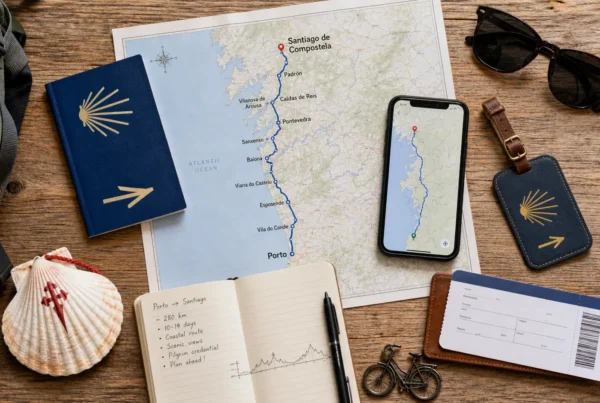
Portuguese Coastal Camino credential stamps have two different roles. They create a record of the places you passed through, but they can also provide the evidence required if you plan to request the Compostela when you reach Santiago.
For a first-time pilgrim, the practical task is simple: get an accepted credential before you start walking, understand when two stamps per day become important, and keep the credential safe until Santiago. Collecting extra stamps for the memories is optional.
Key takeaways
- The pilgrim credential is the document used to record your Camino through dated stamps collected along the route.
- The Santiago Pilgrim's Reception Office only accepts credentials issued by the Cathedral or by organizations authorized to distribute them.
- For the Compostela, walkers and pilgrims on horseback need at least 100 continuous kilometers on an accepted route to Santiago. Cyclists need at least 200 kilometers.
- The official Pilgrim's Office says you should have at least two stamps per day during the qualifying final 100 kilometers on foot or horseback, or 200 kilometers by bicycle.
- Porto Cathedral is listed by the Santiago Pilgrim's Office as an authorized credential distributor. A new Porto Pilgrim Office also opened near the cathedral in 2026 and offers credentials.
- Extra decorative stamps can make the credential a better souvenir, but they do not replace the official distance and stamping requirements.
What is the Camino pilgrim credential?
The Credencial del Peregrino is the document that identifies you as a Camino pilgrim and provides space for the stamps collected during your journey.
The official Santiago Pilgrim's Reception Office guidance on the credential describes two main practical purposes: documenting the pilgrimage when requesting the Compostela and providing access to pilgrim accommodation that requires a credential.
It is sometimes described informally as a Camino passport, but it is not an identity document. Keep your actual passport or national ID separately.
For a first-time pilgrim starting in Porto, it is better to organize the credential before the first walking morning. That avoids searching for one after you have already started your stage.
What are the official Compostela requirements?
The credential and the Compostela are related, but they are not the same thing. Carrying a credential does not automatically qualify you for a Compostela.
The current official Compostela requirements set minimum distance, route and pilgrimage conditions.
| Situation | Official requirement | What it means for your planning |
|---|---|---|
| Walking or horseback | At least 100 continuous kilometers on the same recognized route to Santiago, including the final stage into Santiago Cathedral. | A full pilgrimage from Porto is longer than the minimum, but shorter itineraries need more careful checking. |
| Starting outside Spain | If you start a recognized route outside Spain, the official rules require at least 70 kilometers of the qualifying journey to be completed in Spain. | This matters most if you shorten the route or design an unusual starting point. |
| Cycling | At least 200 kilometers under the same route conditions. | Do not apply the 100 kilometer walking rule to a cycling Camino. |
| Credential stamps | At least two stamps per day during the qualifying final 100 kilometers for walkers and pilgrims on horseback, or final 200 kilometers for cyclists. | Once you enter the qualifying section, make two dated stamps per day your default routine. |
| Purpose of the pilgrimage | The Cathedral describes the Compostela as recognition of a pilgrimage made for religious or spiritual reasons. | Do not treat the Compostela as simply an automatic sports or distance certificate. |
If you are only completing the minimum qualifying distance in separate stages, the Pilgrim’s Office has an additional instruction: your credential should demonstrate where each stage ended and resumed, with corresponding dates.
How many Camino stamps should you collect each day?
The simplest rule for first-time pilgrims is to separate the journey into two parts.
Before the qualifying final distance: collect stamps as a regular record of your journey. There is no need to turn every café stop into a search for another stamp.
During the qualifying final distance: collect at least two stamps every day. This is the part of the credential that matters most when your pilgrimage is reviewed in Santiago.
A useful routine is one stamp around the beginning of your walking day and another later in the stage or at your overnight stop. The exact locations matter less than creating a clear, dated record of your progress along the Camino.
If a stamp does not automatically include the date, make sure the date is recorded clearly.
Where can you get stamps on the Portuguese Coastal Camino?
The Santiago Pilgrim’s Office says stamps are available in many places along Camino routes, particularly during the final 100 kilometers.
Common official examples include:
- pilgrim hostels and other accommodation
- parish churches
- monasteries and cathedrals
- hotels
- town halls and municipal offices
- other places participating in the Camino
You may also encounter stamps in cafés, restaurants and other pilgrim services, but availability at an individual business can change. Treat those as convenient opportunities rather than guaranteed stamp points.
The practical rule is not to depend on one named business. If your planned stamp location is closed, ask at your accommodation, a church, municipal office or another established pilgrim service.
Where can you get a Camino credential in Porto?
You have several ways to organize a credential before starting the Portuguese Coastal Camino.
| Option | What is currently verified | What to check |
|---|---|---|
| Authorized Camino association before traveling | The Santiago Pilgrim's Office maintains a list of organizations outside Spain authorized to distribute credentials. | Order early enough for any postal or collection arrangements. |
| Porto Cathedral | Fábrica da Catedral de Porto, at Terreiro da Sé, appears on the Santiago Cathedral's current list of authorized credential distributors. | Confirm credential collection availability before relying on the general cathedral opening hours. |
| Porto Pilgrim Office | The Oficina do Peregrino do Porto opened near Porto Cathedral in April 2026 and states that credentials are available there. | Check its current opening schedule shortly before your arrival. |
Getting your credential at Porto Cathedral
The official Santiago list of authorized credential distributors includes Fábrica da Catedral de Porto at Terreiro da Sé.
The Diocese of Porto currently lists public opening hours for the church, museum and cloisters as 09:00 to 18:30 in summer and 09:00 to 17:30 in winter, with closures at Christmas and Easter. These are general cathedral hours, not a guarantee that credential distribution follows exactly the same schedule.
If collecting the credential from the cathedral is important to your arrival plan, confirm directly rather than arriving shortly before closing.
The new Porto Pilgrim Office
Porto gained another practical starting point in April 2026 when the Oficina do Peregrino do Porto opened at Rua da Pena Ventosa 38, beside the cathedral area.
Its website states that pilgrims can obtain credentials there. As of August 2026, it publishes high-season hours of 07:00 to 12:30 and 14:30 to 17:00, with Sunday and holiday afternoons closed. Its published low-season schedule is 10:00 to 12:00.
Opening arrangements are more likely to change than the general credential rules, so check the office’s current information shortly before your trip.
You can also see our Portuguese Coastal Camino 2026 updates for broader current planning changes affecting pilgrims starting in Porto.
Do all your Camino stamps need to count toward the Compostela?
No. This is where the practical requirement and the souvenir value of the credential should be separated.
The stamps needed for the Compostela are evidence that you completed the qualifying Camino. Their job is to show a credible sequence of places and dates.
Everything beyond that can be personal.
You may want extra stamps from places that matter to you, such as a church, town, accommodation or memorable stop. They can turn the credential into a compact record of the journey.
There is no advantage in chasing extra stamps at the expense of your walking day. First protect the required record. Treat the rest as optional.
What should you organize before your first walking day?
- Get a credential issued by the Cathedral or an organization recognized to distribute accepted credentials.
- Complete the personal information required on the credential.
- Record your starting point and obtain your first stamp before or when you begin the Camino.
- Keep the credential somewhere protected from rain, leaking water bottles and repeated folding.
- Know when your qualifying final distance begins and use two stamps per day from that point onward.
- Check that your stamps form a logical sequence of dates and locations as you progress toward Santiago.
- Do not rely on one particular café, hotel or business as your only possible stamp location.
If you are also organizing flights, accommodation, baggage or your first stages, use our guide to Portuguese Coastal Camino logistics in 2026 before locking the rest of your plan.
What happens to your credential when you reach Santiago?
Your credential becomes the evidence used when the Pilgrim’s Reception Office checks your pilgrimage and, if you meet the requirements, processes the Compostela.
As of August 2026, the Pilgrim’s Reception Office is at Rúa Carretas 33 in Santiago de Compostela and publishes opening hours of 09:00 to 19:00 every day, except December 25 and January 1.
The office currently uses a ticket with a QR code to manage the queue. It also warns that during periods of heavy demand, receiving the Compostela on the same day cannot be guaranteed.
That is another reason not to build a tight flight or train connection immediately after your expected arrival in Santiago.
FAQ about Camino credentials and stamps
Do I need two stamps every day from Porto?
The official two-stamp rule applies to the qualifying final distance used for the Compostela: at least the final 100 kilometers for walkers and pilgrims on horseback, or the qualifying 200 kilometers for cyclists. Collecting regular stamps before that point still gives you a clearer record of the complete journey.
Do my stamps have to come from churches?
No. The Pilgrim’s Office lists churches, pilgrim hostels, hotels, town halls and other places along the Camino as possible stamp locations.
Can I collect more than two stamps in one day?
Yes. Additional stamps can become part of your personal record of the Camino. Just make sure the required stamps remain clear and dated.
Can I get my credential before arriving in Portugal?
Yes. The Santiago Pilgrim’s Office maintains lists of authorized organizations in several countries that distribute accepted credentials. This can be the simplest option if you want everything prepared before your flight.
Is the Compostela free?
The Santiago Pilgrim’s Office states that issuing the Compostela itself is free. Credential prices or requested contributions can vary by issuing organization, so confirm the current arrangement where you obtain yours rather than assuming one universal price.
Your next step before leaving Porto
Have your credential in hand before the first morning if possible. Check that your details are complete, get your starting stamp, protect the document from rain and remember the rule that matters most near Santiago: at least two dated stamps per day during the qualifying final distance.
Once that routine is clear, the credential becomes one of the simpler parts of your Camino logistics rather than something you need to think about every few kilometers.