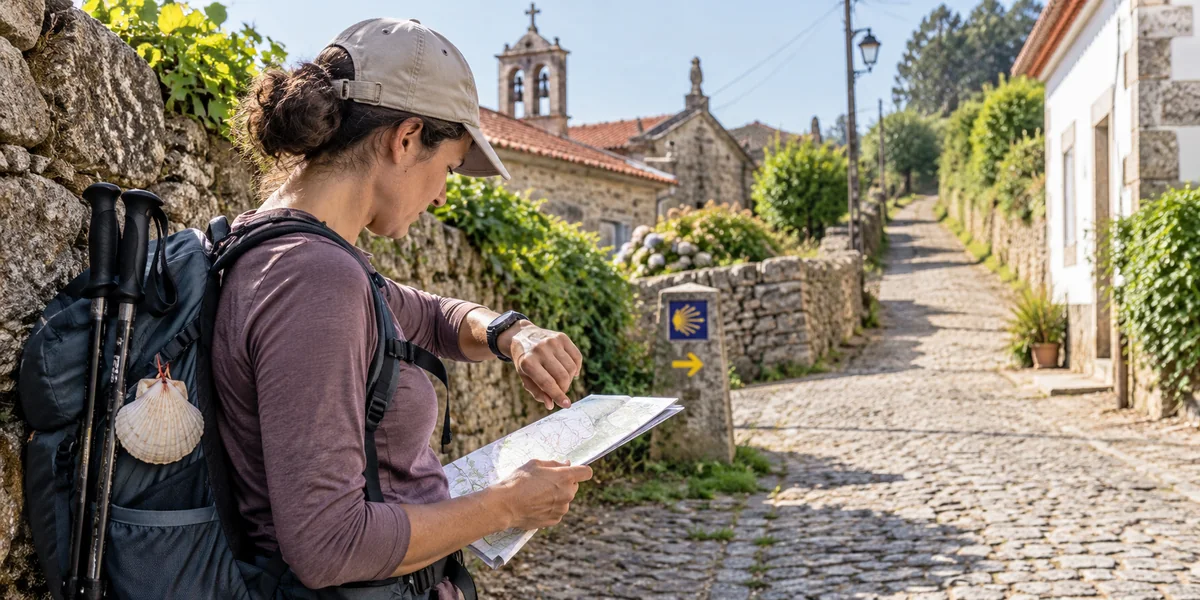
Portuguese Coastal Camino walking time depends on the distance you actually walk, your moving pace and the time you spend stopped. At 4 km/h, a 20 km stage takes five hours of walking. Lunch, breaks, navigation and the walk to your accommodation make the full day longer.
Plan the time between leaving one accommodation and reaching the next. That gives you a more useful arrival estimate than a guidebook’s walking duration alone.
Key takeaways
- Use a pace you have tested over several hours, rather than your fastest short walk.
- Keep moving time, planned stops and a contingency margin separate.
- Check the route between your actual accommodations, including your chosen variant.
- Review consecutive days together before deciding that a long stage fits your itinerary.
How many hours does it take to walk 15 to 30 km?
Divide the walking distance by your average moving speed. The table uses three illustrative speeds; they are calculation scenarios, not measured averages for Camino pilgrims.
| Distance | 3 km/h | 4 km/h | 5 km/h |
|---|---|---|---|
| 15 km / 9.3 mi | 5 hr | 3 hr 45 min | 3 hr |
| 20 km / 12.4 mi | 6 hr 40 min | 5 hr | 4 hr |
| 25 km / 15.5 mi | 8 hr 20 min | 6 hr 15 min | 5 hr |
| 30 km / 18.6 mi | 10 hr | 7 hr 30 min | 6 hr |
For readers using miles, those speeds are approximately 1.9, 2.5 and 3.1 mph. All times exclude stops and assume a consistent moving speed. Your pace may change with the surface, climbing, conditions and the distance already walked.
What does a five-hour walking stage look like as a full day?
Moving time covers the walking itself. Elapsed time includes everything from departure to arrival. For an illustrative 20 km day at 4 km/h, the difference might look like this:
| Activity | Example time |
|---|---|
| Actual walking | 5 hr |
| Two short breaks | 20 min |
| Lunch stop | 30 min |
| Navigation and other stops | 20 min |
| Total before contingency | 6 hr 10 min |
These stopping times are an example, not a recommended break schedule. You may need different breaks or find that suitable stopping places do not match your preferred timing.
If you wanted to arrive by 3:00 PM, this example would require an 8:50 AM departure, with no extra contingency. Adding an illustrative 30-minute margin would move departure to 8:20 AM. Choose the margin from your own stage and constraints; 30 minutes is not a universal allowance.
Check your booking’s actual arrival arrangements too. A preferred arrival time is different from a property’s check-in window or latest arrival time.
Two real stage distances to put the calculation in context
The Xunta de Galicia’s stage references give useful examples from the later part of a Portuguese Coastal Camino journey:
- Pontevedra to Caldas de Reis: the official reference lists 22.9 km, approximately 14.2 miles. At an assumed 4 km/h, that is about 5 hr 44 min of moving time.
- Caldas de Reis to Padrón: the official reference lists 18.7 km, approximately 11.6 miles. At the same assumed speed, that is about 4 hr 41 min of moving time.
The times above are our calculations from distance and assumed speed, rounded to the nearest minute. They are not the Xunta’s published duration estimates or measurements of a pilgrim’s actual journey. Neither includes your stops, accommodation detours or a contingency margin.
Even consecutive stages need separate estimates. Use the distance and profile of your chosen track, then adjust the plan to your own walking experience.
Does the stage distance reach your actual accommodation?
A published stage may run between town centers, churches or other route points. Your accommodation may be outside those endpoints, and a route variation or food stop can add distance.
Before calculating the day:
- Pin your departure accommodation and the exact destination for the next night.
- Check which Coastal Camino route or variant your saved track follows.
- Measure the intended walking route between those addresses.
- Include any planned detours that materially change the distance.
Use the Portuguese Coastal Camino stages from Porto guide to place that day inside the wider itinerary.
What can change your pace on the Coastal Camino?
The route is not one continuous flat promenade. Urban sections, paved roads, cobbles, paths and climbing can make a familiar training pace a poor match for a particular stage.
Rain, wind, visibility and navigation stops can also change the day. A saved offline route helps you prepare, but current conditions still matter. The rainy-day planning guide explains when to reassess the original plan.
Think beyond the first morning. A pace that works on one isolated walk may be harder to repeat after several walking days. Use a pace you can comfortably sustain with the equipment you intend to carry.
How can you test your walking-time estimate?
Use a training walk to collect your own figures:
- Choose a route long enough to test several hours on your feet, with relevant surfaces and elevation where possible.
- Wear your intended footwear and carry your planned daypack or backpack.
- Record distance, moving time and total elapsed time separately.
- Note the breaks and delays, then repeat the test, including a following-day walk if appropriate for your circumstances.
Check whether the time shown by your watch or app includes stops before using it in your plan.
For the broader preparation process, use the Portuguese Coastal Camino training plan.
What should you change if the day looks too long?
First identify the constraint: distance, departure time, destination location or a fixed arrival arrangement. An earlier start changes your arrival time, but it does not reduce the hours you need to walk.
A different overnight stop or an extra walking day may help. Check actual accommodation options and the effect on the following stage before changing bookings.
Baggage transfer may change your personal experience of carrying the load, but it does not reduce the stage distance. If relevant, review the baggage transfer options from Porto separately.
FAQ
Should I include lunch in my walking-time estimate?
Include lunch in the total elapsed time for the day. Keep it separate from moving time, which measures only the walking itself.
Can I complete a 25 km stage in five hours?
Five hours of moving time requires an average moving speed of 5 km/h, about 3.1 mph. That calculation excludes every stop and assumes the distance matches your actual route. Use your tested pace to decide whether that moving-time estimate fits your plan.
Your next step: calculate one real Camino day
Choose the longest stage in your draft itinerary and write down five things: the distance between your accommodations, your tested moving pace, expected stops, a contingency margin and your arrival arrangements.
Work backwards to a departure time, then check the following day. If the plan relies on walking faster than you have tested or leaves too little room for changes, adjust the stage before booking.