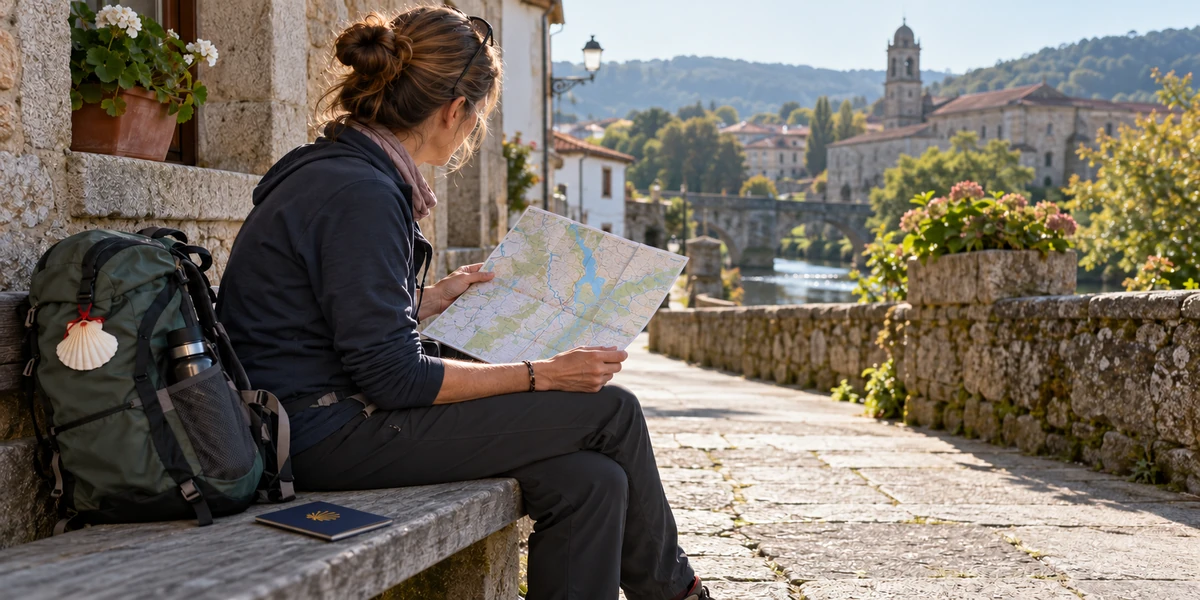
Choosing between the Variante Espiritual and the standard Portuguese Camino changes your remaining walking days, overnight stops and transport plans. Decide before leaving Pontevedra, while you can still adjust the nights ahead.
The standard route through Caldas de Reis is the simpler choice if you want to keep an established walking itinerary. The Variante Espiritual suits a pilgrim who actively wants the route through Poio, Combarro and Armenteira and can organize the boat journey from Vilanova de Arousa. The extra planning is part of choosing that itinerary.
Key takeaways
- Both options can follow a Portuguese Coastal Camino journey. Your route choice earlier in Portugal does not settle this decision.
- The standard route continues through Caldas de Reis towards Padrón. The variant takes a separate itinerary through Armenteira and Vilanova de Arousa.
- A common variant plan uses two walking days followed by a boat-and-walk day. Compare that whole sequence with your existing bookings.
- Confirm the sailing and your overnight stops before relying on a particular arrival date in Santiago.
Where do the two itineraries separate?
The decision comes shortly after Pontevedra, on the way towards the Alba area. Following the standard route keeps you heading towards Caldas de Reis. The Variante Espiritual leads towards Poio and Combarro, then inland to Armenteira.
Poio’s municipal tourism information describes the variant as a connection between the Portuguese Way and the maritime itinerary through Arousa and the Ulla River. It is a separate sequence of stages, rather than a brief diversion that brings you back to Caldas later that day.
Use a current route reference and follow the appropriate waymarks. A rough distance from the center of Pontevedra is not a substitute for identifying the actual junction.
Which option fits your trip?
| Your priority | Option to consider | Planning consequence |
|---|---|---|
| Keep your existing Caldas de Reis and Padrón nights | Standard route | Your current overnight sequence remains relevant. |
| Visit Combarro and walk through Armenteira | Variante Espiritual | Build a different stage plan and confirm the places where you will sleep. |
| Include the Traslatio boat journey | Variante Espiritual | Match the sailing to your arrival in Vilanova de Arousa and your onward walking plan. |
| Keep every day entirely on foot | Standard route | A fully walked alternative around the variant’s boat section needs its own researched itinerary. |
| Protect a tightly scheduled arrival in Santiago | Standard route, unless the variant is already organized | Avoid adding an unconfirmed sailing to a plan with little room to change. |
What does the standard route involve?
A useful reference plan is Pontevedra to Caldas de Reis, then Caldas de Reis to Padrón. The Xunta’s Portuguese Way stage page lists the first stage at 22.9 km, about 14.2 miles. Its Coastal Way reference for Caldas to Padrón gives 18.7 km, about 11.6 miles.
Those are reference stages, not compulsory walking days. Your accommodation location, chosen track and any shorter splits affect the distance you actually walk.
This option keeps the remaining journey as a walking plan without a boat connection. It still needs preparation: the Xunta rates both reference stages as medium difficulty, and the route includes changes of direction, road crossings and mixed walking surfaces.
For the detail behind those days, use the Pontevedra to Caldas de Reis stage guide and the Caldas de Reis to Padrón stage guide.
What changes on the Variante Espiritual?
The familiar overnight sequence becomes Armenteira and Vilanova de Arousa, followed by the boat to Pontecesures and onward walking towards Padrón. The Spanish Camino associations federation’s route catalogue treats the variant as its own staged itinerary continuing to Padrón.
The first walking day takes you through Poio and Combarro towards Armenteira. Check the elevation profile as well as the kilometres: the route includes uphill walking, and reaching a monastery in the hills is a different day from staying beside the water.
The next day includes the riverside mill paths associated with the Ruta da Pedra e da Auga before continuing towards Vilanova de Arousa. The federation’s Armenteira to Vilanova stage description also includes later rises, roads and settlements. Treat it as a full walking stage.
Distance figures need context. La Barca del Peregrino’s itinerary outline uses 23 km for Pontevedra to Armenteira and 24 km for Armenteira to Vilanova. Other tracks use different starting points or alignments. Compare the exact route from your bed to your next bed, and keep walking distance separate from sailing distance.
How many extra days should you allow?
Compare complete overnight plans. For example, a standard-route plan might have nights in Caldas de Reis and Padrón before walking into Santiago. A variant plan might have nights in Armenteira, Vilanova de Arousa and Padrón before the same final walking stage.
In that example, the variant adds one day. It is an itinerary comparison, not a guaranteed rule. A different departure time, an unavailable room or your preferred walking distances can change it.
After the boat, you may choose to stop in Padrón or walk farther along the main route. Decide using the confirmed landing time, remaining daylight, your energy and the accommodation you have arranged. The Xunta lists Padrón to Santiago at 24.8 km, about 15.4 miles. Combining the boat with that whole stage is a substantial day, not an automatic way to save time.
Work backwards from your intended arrival, using the Padrón to Santiago planning guide to decide how you want the final morning to work.
What must you confirm about the boat?
The sailing commonly connects Vilanova de Arousa with Pontecesures. You still need an onward walking plan: a ticket described as going to Padrón does not necessarily mean the boat lands in the town itself.
Check the departure for your actual date. One operator’s reservation information makes the timing tide-dependent, while another page on the same site gives a different seasonal boundary. A generic month range or an advertised morning time is not a confirmed sailing.
- Confirm the date, boarding location, check-in time and landing point.
- Ask what happens if conditions prevent departure, including changes and refunds.
- Check luggage arrangements and any specific boarding needs with the chosen operator.
- Leave enough room in the plan to change your onward night if necessary.
If no suitable sailing is confirmed before you leave Pontevedra, keeping the standard route may be the more practical decision. Once you are in Vilanova, investigate a changed sailing or a properly planned land alternative before assuming that the remaining journey is a short walk.
Book the actual overnight stop, not just the place name
Armenteira is a useful example. The monastery’s own pilgrim information distinguishes its monastic accommodation from a hotel or albergue and sets out reservation conditions. Do not assume that a plan mentioning the monastery includes a bed there.
Confirm the actual accommodation, arrival arrangements and any meals you need. If using baggage transfer, give the provider the new route and each specific accommodation; check acceptance with both sides before changing your original reservations.
Will the boat affect your Compostela?
Check this against your complete itinerary before relying on the certificate. The Pilgrim’s Office requirements include continuous walking on a recognized route and specific conditions for journeys begun outside Spain.
The page checked does not give a variant-specific ruling for your start point and boat journey. Do not treat sailing kilometres as kilometres walked, or a stamp obtained on board as proof that every requirement is met. If the Compostela matters to your trip, ask the Pilgrim’s Office about your exact route and travel method before booking.
A checklist before leaving Pontevedra
- Count your remaining days through arrival in Santiago, including any rest or travel buffer.
- Choose the full itinerary and check its walking distances and elevation profile.
- Confirm the next overnight stops and review the change conditions on existing bookings.
- For the variant, confirm the boat and the walk after landing.
- Resolve any certificate question and update baggage arrangements if relevant.
Is the Variante Espiritual worth choosing?
Choose it when Combarro, Armenteira, the mill paths and the maritime journey are experiences you want to make time for, and the practical arrangements fit your remaining days.
Keep the standard route when your current walking plan works and you prefer to continue through Caldas de Reis. Neither choice needs to prove anything about the value of your pilgrimage.
Before committing, place both options inside your overall Portuguese Coastal Camino stage plan. Compare the nights, confirm the dependencies and choose the itinerary you can comfortably carry through to Santiago.