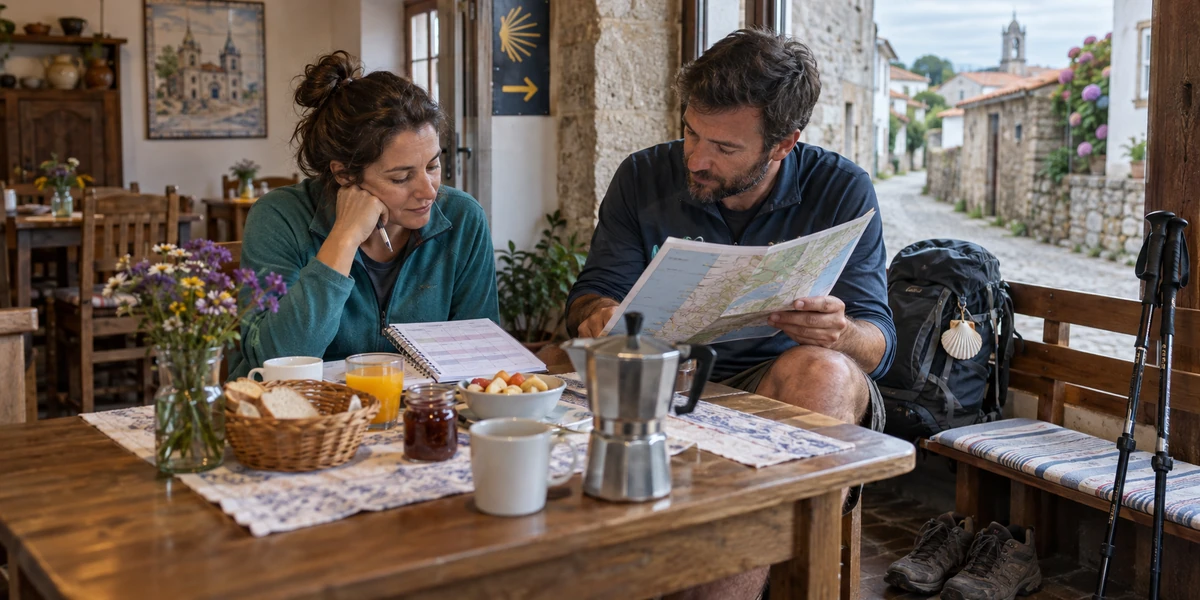
A Portuguese Coastal Camino rest day is worth planning if it gives your itinerary a realistic margin. But you do not automatically need a full day off walking. For some first-time pilgrims, a shorter stage is more useful. For others, keeping an extra day available without deciding when to use it gives them the most flexibility.
The important distinction is between three different choices: resting for a full day, walking a shorter distance, and reserving a spare calendar day. They solve different problems, and each affects your accommodation, budget and arrival plan.
Key takeaways
- There is no universal rule to take a rest day after a fixed number of Camino stages. Plan around your own walking pace, route and available time.
- A full rest day means staying in the same place without advancing along the route. You may need an additional accommodation night.
- A short stage still moves you towards Santiago, but you must check where the shorter distance actually ends and whether you can stay there.
- A buffer day is spare time in your calendar. It can become a rest day, a short-stage adjustment or extra time in Santiago.
- A rest day itself does not invalidate a Compostela. What matters is meeting the official route, distance and credential requirements, including geographical continuity.
Rest day, short stage or buffer day: which should you choose?
The right choice depends on what you are trying to protect: a day with no walking, a more comfortable daily rhythm, or flexibility when plans change.
| Option | When to use it and what to check |
|---|---|
| Full rest day | You want a day without walking. Confirm whether you can stay an extra night in the same place. |
| Short stage | You want a gentler walking day. Check the new overnight stop and the distance you will walk tomorrow. |
| Buffer day | You want spare time for changes. Check which reservations are flexible and budget for an extra night if needed. |
A full rest day is not a more virtuous choice than a short stage, and a shorter stage is not a failure to keep up. Galicia’s official Camino guidance advises pilgrims to adapt stages to their own circumstances and aims rather than treat stage lists as rigid instructions.
When does a full rest day make more sense?
Choose a full rest day when you specifically want a day without a walking stage. It might be for personal time, sightseeing, dealing with ordinary travel logistics or simply because that is the rhythm you prefer.
It is most practical when you can remain in accommodation that suits you for another night. Otherwise, a supposed rest day may involve packing, moving to another property and managing check-in times.
Consider a full rest day before departure if you already know you prefer breaks between several consecutive walking days. You can mark a potential rest location in your draft itinerary without claiming that one town or one point in the route is universally best.
Watch out for: allocating a rest day in a tightly scheduled trip and then compensating with several walking days longer than you intended. A rest day is helpful only if the overall plan still works.
When is a shorter stage the better option?
A shorter stage may suit you better if you want to make progress every day while leaving more time for lunch, arrival and your overnight stop.
The difference becomes clearer when you compare the whole itinerary. Splitting one long stage into two shorter stages normally changes where you sleep, and may increase the number of nights you need. Shortening a stage by shifting its endpoint can also make the following day longer unless you adjust that day too.
For the Portuguese Coastal Camino, overnight stops should be chosen from your actual route track. A place that looks conveniently halfway between two town names may not have the accommodation type you need, and its location may add a detour from the route.
Use our Portuguese Coastal Camino stages from Porto guide to identify your longest planned days. Then test whether a different overnight sequence produces a better fit. Do not assume that you have to follow someone else’s fixed stage list.
What is a buffer day, and why is it different from a rest day?
A buffer day is a calendar day you have not committed to a particular walking stage. You might eventually use it for a full rest, for a shorter-stage arrangement that needs an extra night, or to spend longer in Santiago after finishing.
Its benefit is flexibility rather than guaranteed rest. The main limitation is that flexibility gets smaller once flights, fixed accommodation and luggage delivery arrangements are locked in.
One practical approach is to keep an extra day in your total trip schedule, but not automatically plan to spend it doing nothing halfway through the route. Decide later, subject to your bookings and what changes are actually possible.
It is still important to budget for the possibility that this extra day means paying for another overnight stay and meals. A buffer is not free simply because it has no named stage.
How many days do you actually have for walking?
Before you add a rest day, separate your calendar days from your walking days. Many plans become too tight because arrival and departure are treated as though they cost no time.
Here is an illustrative calculation, not a recommended itinerary:
| Illustrative calendar | Days |
|---|---|
| Total trip | 14 |
| Arrival and departure | 2 |
| Days left for walking or a pause | 12 |
| If 12 days are spent walking | 0 spare |
| If 11 days are spent walking | 1 spare |
Your own numbers may be very different. This example simply shows why adding a rest day after booking travel can be difficult. If there is no spare calendar day, you would need to shorten another part of the itinerary, revise your starting point or change your travel dates.
Where should a rest or short day fit on the Coastal Camino?
There is no single town where every first-time pilgrim should stop for a rest. A suitable choice is a place that works within your route variant, stage distances and accommodation plan.
Review the potential stopping point against four questions:
- Does this location fall on the walking route you have actually selected, rather than a different coastal or shoreline variant?
- Is the accommodation suitable for one or two nights, and can any change be arranged under its current terms?
- Does stopping here leave the following stage within your preferred walking distance?
- Would a different location reduce travel, packing and logistics during the day you want to rest?
If you already have fixed accommodation, the best rest location may simply be wherever an extra night is feasible. If you have not booked yet, compare the fragile nights first. Our guide to booking accommodation on the Portuguese Coastal Camino explains why the level of flexibility depends on your stage and lodging choices.
What if weather or a change of plan makes you want to stop?
A plan should allow you to reconsider a stage rather than force you to follow the original schedule at any cost. Bad weather, transport disruption or changes to your accommodation arrangements can all affect the day’s practical decision.
You have more than two options. Depending on conditions and what is available, you may choose to delay departure, take a full day off, shorten the day’s destination or revise later accommodation bookings.
Do not assume that a shorter stage is automatically a suitable response to difficult conditions. Check current local information and avoid committing to a route you cannot reasonably assess. Our rainy-day planning guide for the Portuguese Coastal Camino offers a separate decision checklist for wet walking days.
If your reason for stopping involves an injury, illness or concerning symptoms, this itinerary guide cannot tell you whether it is appropriate to continue. Seek advice from a qualified local professional when needed.
Will a rest day affect your Compostela?
Taking a rest day does not, by itself, prevent you from obtaining the Compostela. According to the official Galician Camino information, the pilgrimage does not have to be completed on consecutive calendar dates, but the walking route must remain geographically continuous. The official distance, credential and stamping requirements still apply.
A full day in one place is different from skipping a section of the route and resuming farther ahead. If you intend to request the Compostela, check the official credential and Compostela guidance before changing your route plan.
A five-minute rest-day decision checklist
- Write down your total calendar days, including arrival and departure.
- Count the walking stages in your proposed route and identify the longest consecutive days.
- Decide what you actually want: no walking for one day, shorter daily distances or extra time if plans change.
- Check how that choice affects the next two overnight stops, not just one day.
- Confirm accommodation and luggage arrangements before relying on a flexible stop.
- Leave the final arrival and departure plan realistic rather than absorbing all spare time into longer stages.
FAQ: rest days on the Portuguese Coastal Camino
Do first-time pilgrims need a rest day?
Not everyone needs to schedule a full day without walking. Some will prefer one, while others can design shorter stages or reserve an unallocated day. Start with your calendar and a realistic stage plan rather than a fixed rule about how frequently to rest.
Is it better to rest for a whole day or walk a shorter stage?
Choose a full day if your objective is not to walk a stage at all. Choose a shorter stage if you want to continue towards Santiago with a less demanding daily distance. Check the consequences for your following stages and overnight bookings.
Should I book accommodation for a buffer day?
It depends on how flexible your trip is. A pre-booked additional night gives certainty at one place but reduces flexibility to use the day elsewhere. An unbooked night leaves more options but no guarantee of a suitable room. Confirm the conditions that matter for your dates.
Does a rest day interrupt the Camino for Compostela purposes?
A rest day does not itself break the required geographical continuity. If you are applying for the Compostela, preserve the walked route sequence and follow the current official credential and minimum-distance rules.
Your next step: decide what the extra day is for
Take your current itinerary and mark one day as a possible full rest, one long stage you could shorten and one genuinely unallocated day in the travel calendar. You do not have to keep all three options, but comparing them reveals which one addresses your actual concern.
Then recalculate your nights and walking days. Keep the option that makes the complete trip more workable, not the one that simply looks tidier on a stage list.