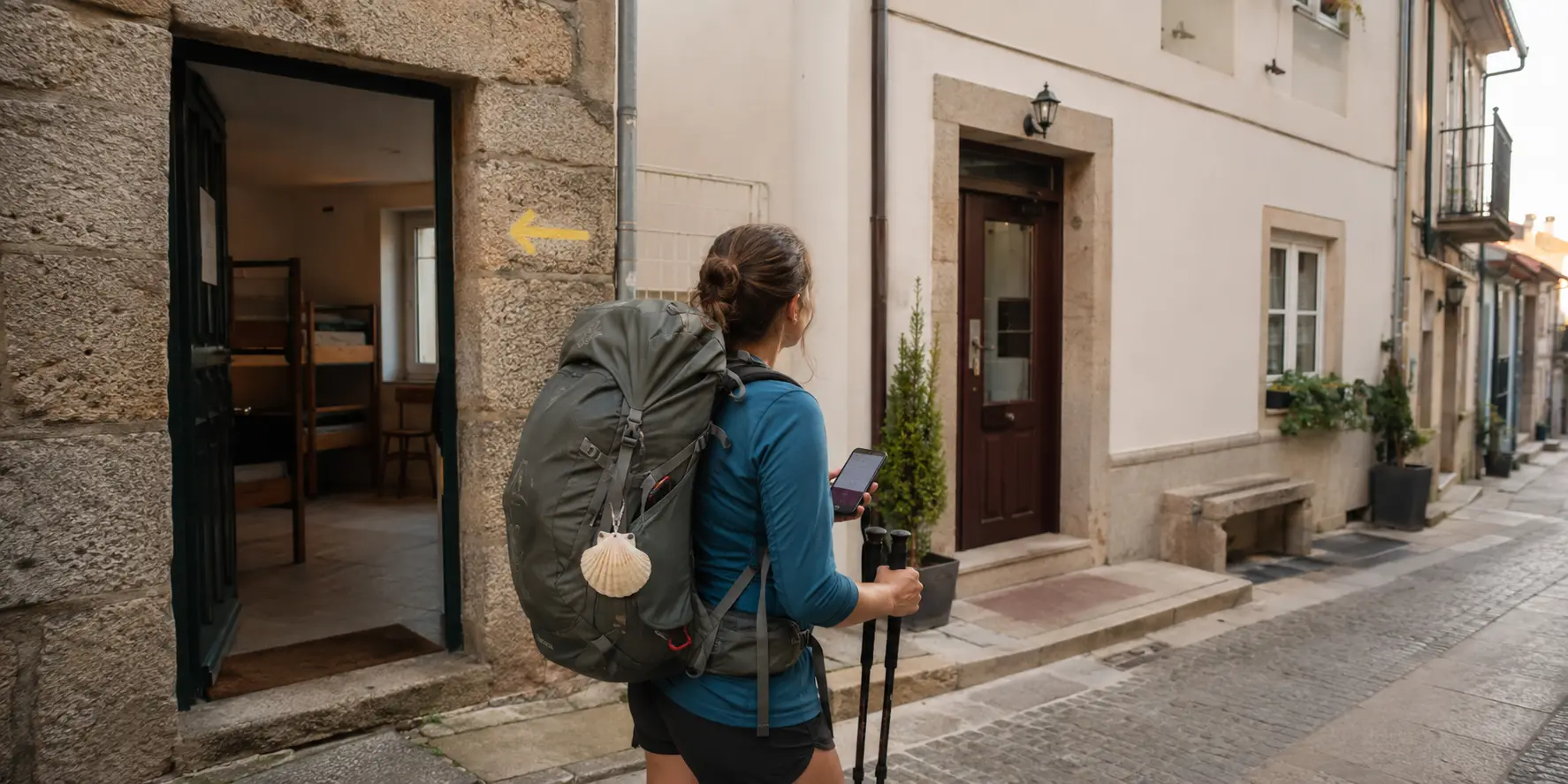
A realistic Portuguese Coastal Camino cost from Porto to Santiago is not one fixed daily number. Two pilgrims can walk the same route and spend very different amounts because accommodation, food, luggage transfer, walking days and the nights before and after the Camino all change the total.
For planning in 2026, a useful on-route allowance starts at roughly €40 to €55 per day for a lean trip, around €60 to €90 for a more balanced approach, and €95 or more if you prefer private accommodation and paid conveniences. These are planning bands, not guaranteed prices.
Key takeaways
- A lean Porto to Santiago budget can start around €40 to €55 per walking day if you mainly use pilgrim accommodation, eat simply and carry your own pack.
- A more flexible budget of roughly €60 to €90 per day gives you more room for private rooms, restaurant meals and occasional paid extras.
- Accommodation is usually the cost decision that changes the total most.
- Public pilgrim hostels in Galicia currently charge €10 per person per night, but private accommodation can cost several times more.
- Pilbeo currently lists its full Porto to Santiago Coastal luggage-transfer package at €94 for 13 stages.
- Keep flights, pre-trip gear and the nights before and after the walk separate from your daily Camino budget.
How much should you budget from Porto to Santiago?
The most practical way to estimate your total is to start with how you expect to travel rather than with somebody else’s spending diary.
| Planning style | On-route allowance | What it assumes | Main limitation |
|---|---|---|---|
| Lean | About €40 to €55 per day | Mainly pilgrim accommodation, simple food and carrying your own backpack | Little room for private rooms, taxis or unexpected changes |
| Balanced | About €60 to €90 per day | Mix of accommodation types, more meals out and some paid conveniences | Several private-room nights can push the total higher |
| Comfort focused | About €95 or more per day | Private accommodation most nights, restaurant meals and luggage transfer | Hotel standard and extra services create a much higher ceiling |
These figures are planning allowances rather than live averages. The better test is whether the accommodation and services you actually want for your dates fit inside the range.
What does that mean for a full Porto to Santiago trip?
Your number of walking days matters almost as much as your daily spending.
Using 13 walking days as a simple planning example:
| Style | Daily allowance | 13 walking days | Before adding |
|---|---|---|---|
| Lean | €40 to €55 | About €520 to €715 | Flights, gear and extra nights |
| Balanced | €60 to €90 | About €780 to €1,170 | Flights, gear and extra nights |
| Comfort focused | €95+ | About €1,235+ | Flights, gear and extra nights |
A 13-day itinerary is only an example. If you take more walking days, every additional day normally means another night of accommodation, another day of food and possibly another luggage transfer.
This is why a slower Camino is not automatically cheaper even if your daily spending stays low.
Accommodation is usually the biggest budget decision
The difference between a pilgrim bed and a private room can reshape the whole budget.
The official public pilgrim-hostel network in Galicia currently charges €10 per person per night. That gives you a useful low-cost anchor for the Spanish section of the route.
Private hostels, guesthouses and hotels are less predictable. Their prices depend on the town, date, room type and remaining availability. A plan based on private rooms therefore needs actual accommodation searches for your travel dates rather than one generic nightly average.
Build your budget around the rooms you will actually choose
Do not create a dormitory-based budget if you already know that you want privacy after most walking days.
A better approach is to classify your nights before calculating the total:
- nights where a pilgrim dormitory is acceptable
- nights where you prefer a private room
- your night in Porto before starting
- your night in Santiago after finishing
- any deliberate rest or recovery night
A mixed strategy can control costs without requiring the cheapest bed every night.
How much should you allow for food?
Food spending depends heavily on habits. A pilgrim using supermarkets, bakeries and simple cafés will spend differently from somebody who wants breakfast, lunch and dinner in restaurants each day.
| Food approach | Budget effect | Best for |
|---|---|---|
| Supermarkets and simple cafés | Supports the lower planning band | Pilgrims prioritising cost control |
| Groceries plus restaurant meals | More flexible middle ground | Most first-time pilgrims |
| Most meals in restaurants | Pushes the daily total higher | Pilgrims who prioritise food and convenience |
Do not make the food allowance so tight that every coffee, second breakfast or snack becomes a budget problem. Walking days do not create identical appetites or meal patterns.
For more practical detail on how meals work during the route, see our guide to food on the Portuguese Coastal Camino.
How much does luggage transfer add?
Luggage transfer is easier to model because the cost is tied to your stage plan.
As a current 2026 reference, Pilbeo lists its Porto to Santiago Portuguese Coastal route package at €94 for 13 stages. That works out at roughly €7.23 per stage for that specific package.
This should be treated as a current price anchor, not a universal Camino luggage price. Providers, routes, individual-stage bookings and supported accommodation can differ.
If you expect to use luggage transfer every day, include it from the beginning instead of treating it as an optional expense you may somehow absorb later.
Before relying on a provider, check your exact route and accommodation against our guide to baggage transfer from Porto on the Portuguese Coastal Camino.
Do not forget the nights outside the actual walk
A common budgeting mistake is to multiply a daily figure by the number of walking days and stop there.
Your trip may also include:
- a Porto night before the first stage
- an extra Porto day if your flight arrives early
- a Santiago night after finishing
- an additional Santiago day before your departure
- airport or station transport
- laundry and small recurring purchases
These costs are part of the trip even though they are not part of the walking-day average.
Keep Camino spending separate from flights and gear
Budget comparisons become misleading when one pilgrim includes international flights and another only reports the money spent between Porto and Santiago.
A cleaner budget has three layers:
- Pre-trip costs: flights, insurance and any gear you still need.
- On-route costs: accommodation, food, luggage transfer, laundry and normal daily extras.
- Trip-edge costs: Porto and Santiago extra nights, airport transfers and onward travel.
This makes it much easier to compare different itinerary lengths and accommodation strategies.
For the wider booking sequence, see our guide to Portuguese Coastal Camino logistics in 2026.
How can season affect your budget?
Seasonality matters most when it changes which accommodation is available to you.
A low-cost plan may depend on dormitory beds or inexpensive rooms. If those options are no longer available for your date and stage, you may have to move into a higher-priced accommodation category.
That does not mean every busy date is automatically expensive. It means the cheapest theoretical budget becomes less robust when it depends on a narrow set of accommodation options.
If your walking dates fall in a popular period, check how busy the Portuguese Coastal Camino may be in 2026 before you assume you can choose the cheapest bed at short notice.
Where first-time pilgrims tend to underestimate the total
- Only counting walking nights. Porto before the start and Santiago after the finish still need accommodation.
- Assuming every night will be cheap. One or two private-room nights can materially change a lean budget.
- Ignoring recurring extras. Laundry, snacks, drinks and small purchases repeat across the trip.
- Adding luggage transfer later. If you already expect to use it, include it from day one.
- Comparing different definitions of “Camino cost”. One total may include flights and equipment while another excludes both.
- Using the shortest possible itinerary just to reduce cost. A cheaper trip is not useful if the stage lengths do not fit how you want to walk.
Can you walk from Porto to Santiago for €35 a day?
It may be possible in favourable conditions, but €35 should not be treated as a dependable default budget for a first-time pilgrim in 2026.
At that level, you have little room for private accommodation, luggage transfer, restaurant-heavy days or unexpected transport. The plan depends on consistently finding inexpensive beds and keeping food and extras tightly controlled.
If €35 is your target, test it against real accommodation for your dates before treating it as your working budget.
How to calculate your Porto to Santiago budget
- Decide how many walking days you realistically want.
- Add your Porto arrival night and Santiago finish night.
- Count how many dormitory and private-room nights you expect.
- Choose a food style that matches how you actually travel.
- Add luggage transfer if you expect to use it.
- Add laundry and a reasonable amount for normal daily extras.
- Keep flights, insurance and new gear in a separate pre-trip category.
- Compare the result with actual accommodation and transport for your dates.
Estimate your own Portuguese Coastal Camino budget
The useful question is not whether another pilgrim spent €45, €70 or €100 per day. It is whether your combination of walking days, accommodation, food and luggage fits the amount you want to spend.
The calculator is a planning tool rather than a live price quote. Use the result as a starting range, then check your actual accommodation, transport and services before booking.
Your next step
Before searching for a single Porto to Santiago total, decide four things: how many days you want to walk, how often you want a private room, whether you plan to transfer your luggage and how many nights sit outside the walk itself.
Those four choices will explain far more about your final Portuguese Coastal Camino cost than one universal daily average.