Portuguese Coastal Camino vs Senda Litoral: Which Route Should You Follow from Porto?
If you are comparing the Portuguese Coastal Camino vs Senda Litoral before leaving Porto, the first thing to know is that the two labels do not always describe the same walking line.
Portugal has an officially certified Caminho Português de Santiago – Caminho da Costa. At the same time, pilgrim maps and specialist guides commonly use Senda Litoral for a shoreline-oriented option, particularly on the first days from Porto.
That difference matters. Choosing one track rather than the other can change how you leave Porto, where you reach the coast, your first-day distance and where your accommodation should be.
Key takeaways
- The Caminho da Costa is an officially certified Camino itinerary in Portugal. Do not assume every shoreline promenade labelled “coastal” online is part of that certified track.
- Senda Litoral is commonly used by pilgrim guides for a shoreline-oriented option, but the terminology is not as formally standardised as the certified Caminho da Costa.
- The biggest practical difference appears around Porto and the early stages, where “walk the Coastal Camino” and “stay beside the ocean” can lead you towards different tracks.
- If you want to follow the formally recognised Caminho da Costa corridor, choose that track deliberately. If your priority is staying close to the Atlantic, use a current route source for the shoreline option rather than relying on the route name alone.
- Choose the route before booking your first walking nights. Accommodation that makes sense for one track may create an unnecessary detour from the other.
Are the Portuguese Coastal Camino and Senda Litoral the same route?
Not reliably.
The confusion starts with the word coastal. A route can be called the Coastal Camino without following the water at every moment. The officially recognised Caminho da Costa crosses urban, suburban and inland sections as it travels north through the Porto region.
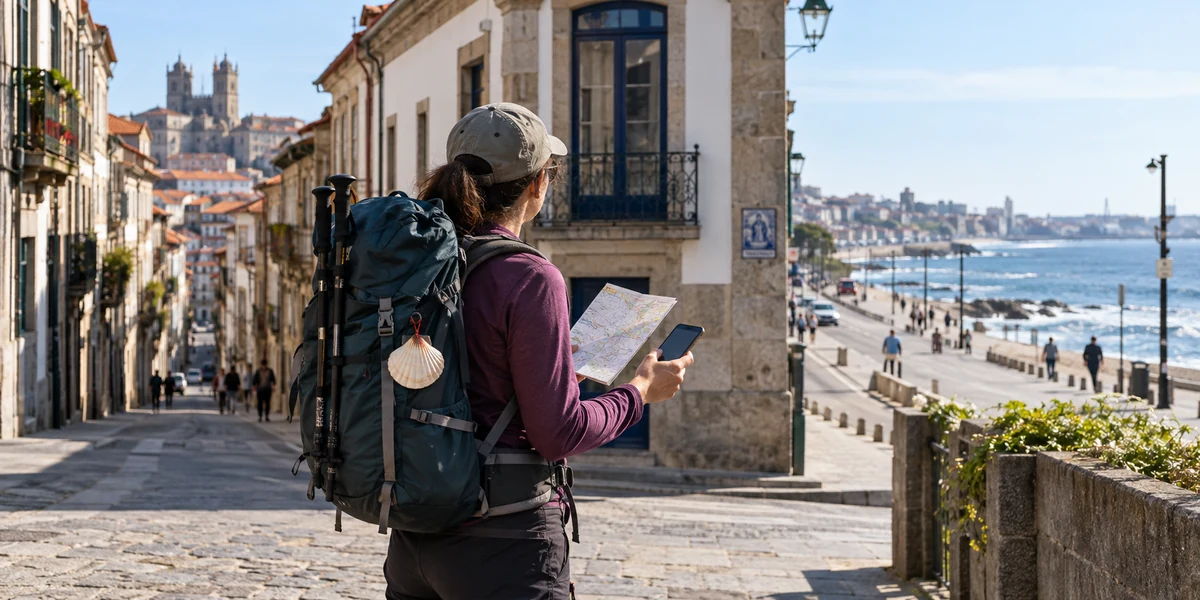
By contrast, current pilgrim guides commonly use Senda Litoral for a walking option that aims to stay closer to the Douro and Atlantic shoreline, including the Porto, Foz and Matosinhos side of the first day.
Some sections may overlap or converge. Other sections can be described differently by different maps and guide publishers.
The practical rule is therefore simple: do not choose your route from its name alone. Check the actual track you intend to walk.
What is the certified Caminho da Costa?
Turismo de Portugal currently lists the Caminho Português de Santiago – Caminho da Costa as a certified itinerary. The Portuguese certified section runs between Porto and the Galician border at Valença and is listed at 137.9 km across nine reference stages.
Visit Porto also publishes detailed information for the Caminho Português da Costa through the city. Its route passes through central Porto before continuing north and entering the municipality of Matosinhos.
This is important because the official route name does not mean “walk directly beside the Atlantic from the cathedral”. A first-time pilgrim who follows the recognised route and a pilgrim who deliberately walks towards the waterfront can therefore leave Porto in different directions.
The certified route can be a useful fit if you want your planning to follow the formally recognised route corridor.
What do pilgrims mean by Senda Litoral?
Senda Litoral is commonly used in contemporary Camino guides for a shoreline-oriented option that stays closer to the coast than the Caminho da Costa in places where the tracks differ.
A typical description starts in Porto, heads towards the Douro waterfront and Atlantic coast, passes through the Matosinhos area and then continues north using coastal streets, promenades, paths and other shoreline sections.
However, treat that description as practical route terminology rather than proof of one universally standardised official track.
Different apps, guidebooks and websites may draw the shoreline option differently. They may also use terms such as Coastal Route, Coastal Path, Litoral Way or Senda Litoral in ways that are not completely consistent.
That inconsistency is exactly why first-time pilgrims should save a current track rather than rely only on the route name.
Portuguese Coastal Camino vs Senda Litoral at a glance
| Planning question | Caminho da Costa | Senda Litoral | What to check |
|---|---|---|---|
| Route status | Certified Camino itinerary in Portugal | Common pilgrim term for a shoreline-oriented option | Do not assume the terminology is identical across every map |
| Leaving Porto | Follows the recognised Camino corridor through the city and north | Usually designed to reach and follow the waterfront and Atlantic coast | Save the exact first-day track before walking |
| Route identity | Formally recognised route corridor | Shoreline-oriented option described differently across some guides | Use a current map or guide for the exact line |
| First-day experience | More urban and inland sections can appear | More emphasis on riverside and coastal walking | Compare actual distance to your first accommodation |
| Best fit | Pilgrims who want to follow the formally recognised route corridor | Pilgrims deliberately prioritising proximity to the sea | Choose based on trip design, not the more attractive name |
Why does the route become confusing around Porto?
Porto is both a Camino starting city and a large urban area. That creates more route possibilities than a simple trailhead in a small village.
A pilgrim can leave the historic centre along the recognised Caminho da Costa. Another can deliberately move towards the Douro and Atlantic before continuing north. A third may take transport to Matosinhos and begin walking there.
All three people may tell friends that they are walking the “Portuguese Coastal Camino”. Their first day can nevertheless look very different.
If the starting-point decision itself is still unclear, compare starting the Camino in Porto or Matosinhos before deciding which route line to follow.
Which route is easier to follow?
If route identity is your priority, the Caminho da Costa gives you the formally recognised corridor to plan around.
That does not mean navigation is automatic. Cities change, waymarks can be missed and construction can temporarily affect a normal route. A current map is still useful.
The shoreline option needs more deliberate preparation because staying close to the sea is not the same as following one formally defined Camino corridor at every point.
A seafront road, promenade or boardwalk continuing north may look obvious, but that does not automatically make it the track used by the guide, app or accommodation plan you selected.
For the Senda Litoral, use a route source that shows the line itself. Do not rely on the instruction “keep the ocean on your left” as a navigation system.
Does choosing the Senda Litoral make the first day longer?
It can change the distance, but avoid treating one published number as universal.
The total depends on where you start in Porto, which shoreline track you use, whether you begin walking in central Porto or Matosinhos, and the exact location of your first accommodation.
This is one reason different Camino guides give different first-stage distances despite using similar destination names.
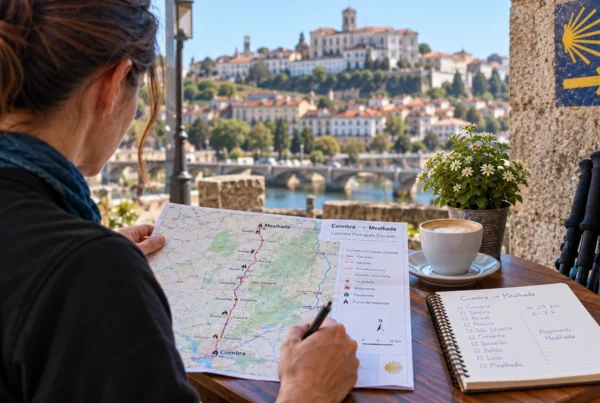
For first-time planning, door-to-door distance is more useful than a headline stage number. Add your actual start, your intended route and your accommodation address to the same map before deciding whether the day is realistic.
For the wider itinerary, use our guide to Portuguese Coastal Camino stages from Porto rather than building the whole trip around one standard stage list.
Does the route choice affect accommodation?
Yes, especially when you deliberately stay close to the shoreline.
An accommodation can be described as being in the same town as your stage endpoint but still sit a meaningful distance from your chosen track. That matters more at the end of a long walking day than it does when looking at a booking map at home.
Before booking the first few nights:
- plot the accommodation against the exact route you intend to walk;
- check whether reaching the property requires an inland detour;
- check where you will rejoin your intended track the next morning;
- do not assume that a hotel labelled “near the Camino” refers to the same Camino variant you chose.
This is particularly important if you intend to alternate between shoreline sections and the certified route.
What about baggage transfer?
Baggage transfer makes route consistency more important, not less.
Your provider needs an accommodation sequence. If your walking route and accommodation route do not match cleanly, you may create awkward detours even if the bag itself arrives correctly.
Do not assume that a baggage company follows the same definition of “Coastal Camino” that your route app uses. Confirm the exact accommodation sequence and service coverage directly before paying.
If luggage affects your stages, include it when you build the route rather than adding it after every overnight stop is fixed.
Which route may fit different first-time pilgrims?
There is no universal winner.
The Caminho da Costa may fit you better if route identity matters most
This can be the better fit if you want to follow the formally recognised Camino corridor and minimise ambiguity over which track your guide means.
It can also suit pilgrims who care more about Camino continuity than spending the maximum possible time beside the Atlantic.
The shoreline option may fit you better if being beside the sea is a priority
The Senda Litoral can make sense if the coastal setting is one of the main reasons you chose this Camino and you are comfortable navigating a deliberately selected shoreline track.
The important part is the word deliberately. Do not choose it because you assumed “Coastal Camino” automatically meant continuous oceanfront walking.
Mixing the two can work, but make each switch intentional
You do not need to treat the decision as irreversible.
Some pilgrims use a shoreline track for particular sections and a recognised Camino route elsewhere. That can work well when you know exactly where you intend to change.
It becomes fragile when the switches happen accidentally because two apps use different route names.
Do not confuse route choice with starting-point choice
Starting in Porto versus Matosinhos and choosing the Caminho da Costa versus a shoreline track are related decisions, but they are not the same decision.
You can start in central Porto and head towards the shoreline. You can also deliberately begin in Matosinhos because you want a shorter first walking day.
If you are arriving by air, the distinction matters even more. “Go directly to the coast” is not a precise transfer plan. Our guide to getting from Porto Airport to your Camino start explains why you should define the exact starting point and route before leaving the airport.
What happens later in Galicia?
The official Galicia Camino authority recognises the Portuguese Coastal Way entering Galicia through A Guarda and continuing through the coastal corridor towards Vigo. After Vigo, it joins the inland Portuguese Way at Redondela.
This creates another reason to avoid treating Portuguese and Galician route terminology as one perfectly uniform naming system.
Portugal’s certified Caminho da Costa documentation and Galicia’s official Coastal Way documentation should each be treated as the primary source for the route in their respective territory.
For the pilgrim, the practical task is not to solve every naming disagreement. It is to know which track you are walking tomorrow.
What should you confirm before leaving Porto?
- Decide whether your priority is the recognised Caminho da Costa or a shoreline-oriented route.
- Save the exact first-day track offline instead of relying only on the words “Coastal Camino”.
- Confirm whether you will start in central Porto or deliberately begin later, such as in Matosinhos.
- Measure the route to your actual first accommodation rather than only to the town centre.
- Check that the first few accommodations make sense for the same route variant.
- If you use baggage transfer, confirm the accommodation sequence directly with the provider.
- Check current municipal or Camino information shortly before departure in case temporary works affect the route.
- When two sources disagree, identify which route each source is describing before assuming one is wrong.
FAQ
Is the Senda Litoral the official Portuguese Coastal Camino?
Do not treat the terms as interchangeable. Portugal has an officially certified Caminho da Costa. Senda Litoral is commonly used by pilgrim guides for a route that stays closer to the shoreline, but the terminology and exact alignment are not as formally standardised across sources.
Does the Caminho da Costa stay beside the ocean from Porto?
No. “Coastal” does not mean continuous oceanfront walking. The recognised route includes urban and inland sections, particularly around the Porto area.
Can I walk beside the Douro and Atlantic from Porto instead?
Yes, pilgrims commonly use a shoreline-oriented route from Porto towards Foz and Matosinhos. Use a current track for the exact route rather than assuming it matches the certified Caminho da Costa.
Can I switch between the routes?
Potentially, but plan the switch rather than improvising it from the names on different apps. Check your accommodation, distance and navigation before changing tracks.
Which route should a first-time pilgrim choose?
The Caminho da Costa may fit better if you want to follow the formally recognised route corridor. The shoreline option may fit better if staying closer to the Atlantic matters more and you are comfortable using a current route track. Neither choice is automatically better for every pilgrim.
Your next step
Before booking your first walking night, open the route source you actually intend to use and trace the first day from your exact starting point to your accommodation.
If that line matches the experience you want, keep building the itinerary from it. If it does not, change the route before you change hotels, baggage services and the rest of your stage plan.
The useful question is not simply “Which coastal route is correct?” It is “Which route have I deliberately planned to follow?”