The Vila do Conde to Esposende Camino is best planned as a roughly 24 km walking day, rather than around one exact number copied from a stage list. Current route measurements differ slightly depending on the track and the points used to start and finish the measurement.
For a first-time pilgrim, the more useful questions are where you will actually sleep, which coastal track you intend to follow, where you can resupply without depending on one particular café, and how this stage fits between your first day from Porto and the walk north from Esposende.
Key takeaways
- Plan on roughly 24 km from Vila do Conde to Esposende, then check the distance from your actual accommodation to your next bed.
- The certified Caminho Português da Costa and a route that simply stays as close to the shoreline as possible are not always the same track.
- Póvoa de Varzim comes early in the day, so use it to deal with food, water or anything you forgot rather than assuming later stops will match your timing.
- Do not treat a relatively low-climbing stage as an automatic recovery day. Around 24 km still means several hours on your feet.
- Plan Esposende together with the following stage. Sleeping farther north than the town centre changes both today's distance and tomorrow's walk.
How far is the Camino from Vila do Conde to Esposende?
A sensible planning number is about 24 km.
Current published measurements illustrate why an exact figure can be misleading. The Federación Española de Asociaciones de Amigos del Camino de Santiago lists the stage at 24.3 km. A current 2026 route guide measuring from the tourism office in Vila do Conde to the tourism office in Esposende records 23.7 km.
That difference is small enough not to change the character of the day, but it matters if you add another kilometre or two at either end to reach accommodation.
The practical rule is to use the stage distance for initial planning, then measure your door-to-door route. A guide ending in central Esposende does not automatically describe the distance to a bed in Marinhas or another location farther north.
| Planning point | Why it matters | What to do |
|---|---|---|
| Stage distance | Published tracks differ slightly | Use roughly 24 km, then check your own route |
| Route choice | The signed Coastal Way and a shoreline track can diverge | Decide which route you intend to follow before the walk |
| Food and water | Your timing may not match seasonal business hours | Use larger towns to resupply and carry a sensible buffer |
| Accommodation | Your bed may sit beyond the usual stage endpoint | Measure the final walk to your accommodation |
Which route should you follow from Vila do Conde to Esposende?
This is where a simple coastal stage can become confusing.
The Caminho Português da Costa is a certified and signposted Camino route. A shoreline track, often described by pilgrims as the Senda Litoral, may keep you closer to the water in places. The two should not be treated as interchangeable simply because both head north along the coast.
Current guidance from Esposende’s municipal tourism authority specifically tells pilgrims to use the certified, signposted itinerary. Within the municipality, the route is marked with milestones, signs and directional arrows.
That gives you a useful rule for this stage: do not follow every seafront promenade or boardwalk just because it continues north. If your route app and the Camino signs disagree, check which track you deliberately chose rather than assuming the path closest to the sea is the official Coastal Way.
If you intentionally prefer a shoreline variant, that can be a valid itinerary choice. Just expect your distance and junctions to differ from a guide measuring the certified route.
What does the stage look like in practical terms?
Vila do Conde to Póvoa de Varzim
Póvoa de Varzim arrives only a few kilometres after Vila do Conde, which makes it an unusually early decision point.
If you left Vila do Conde without breakfast, need food for later, want to refill before the less urban part of the day or realise you forgot something, deal with it here. There is little benefit in deliberately postponing an easy resupply because a map happens to show another café farther ahead.
If you started the morning well supplied, you may prefer simply to keep walking. The point is not that every pilgrim needs a stop in Póvoa. It is that this is the easiest part of the stage in which to correct a poor morning plan.
After Póvoa de Varzim
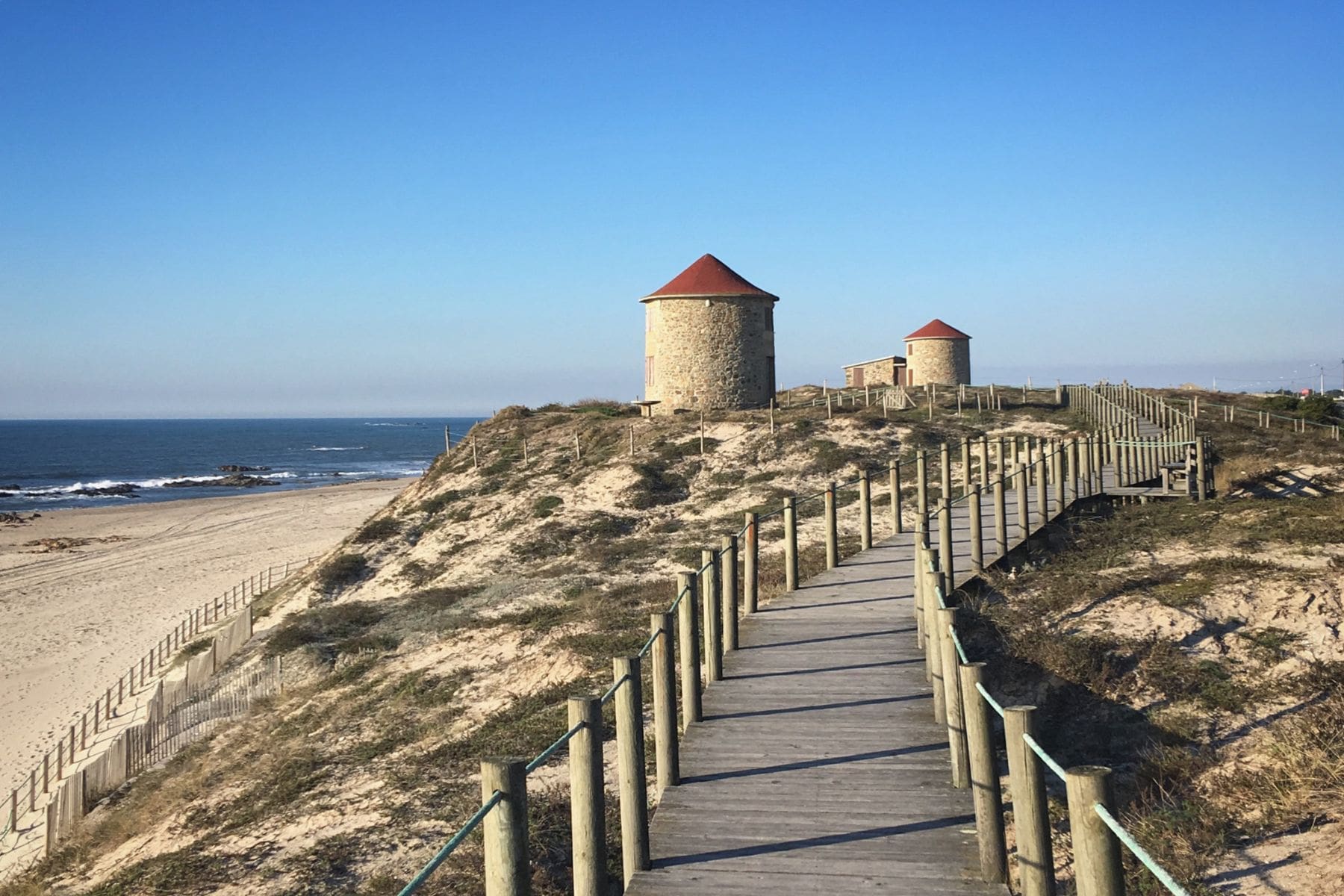
The day becomes more clearly coastal as you continue north towards Apúlia and the Esposende area. Expect a mixture of paved sections, coastal paths and boardwalk sections rather than one continuous walking surface.
Current route guides also flag a practical change after the early urban section: businesses farther along the route can have more variable opening patterns, particularly outside the busiest periods.
Do not build the day around reaching one named café at one particular hour. Carry enough food and water to continue comfortably if the place you expected to use is closed.
Apúlia, Fão and the approach to Esposende
By Apúlia you are within Esposende municipality. The municipality says its certified Camino itinerary continues for about 20 km through its territory, from Apúlia north to Antas, well beyond the endpoint of this stage.
For this walking day, your attention should remain on your chosen endpoint. Fão and Esposende are useful reference points near the end of the stage, but your accommodation address matters more than the name printed at the top of a stage guide.
Is Vila do Conde to Esposende a good one-day stage for a first-time pilgrim?
For many pilgrims, roughly 24 km is a reasonable full walking day. That does not make it the right distance for everyone.
The most useful test is what happened on the previous day. If your Porto to Vila do Conde Camino stage already felt longer than expected, repeating another long day simply because a standard itinerary tells you to may be a poor decision.
If you have already tested similar distances before the Camino and the previous day went comfortably, there is little reason to complicate this stage just to make it shorter.
If 24 km is beyond the walking range you planned for, shorten the stage deliberately. Choose the overnight location first, verify accommodation and then recalculate the following day. Do not stop somewhere at random and leave the consequences for the next morning.
Should you stay in Esposende or walk farther north?
This is one detail that can quietly change your itinerary.
Esposende’s municipal tourism information continues to reference the Albergue de São Miguel de Marinhas in 2026. Marinhas is north of central Esposende, so a pilgrim staying there should not assume that a roughly 24 km stage ending in central Esposende matches their own walking distance.
Walking farther today can make sense if you deliberately want to shorten the next stage. It is less useful if you only discover after 20-plus kilometres that your accommodation adds extra distance to a day you expected to be finished.
Before booking, look at this stage and the Esposende to Viana do Castelo stage together. Moving your overnight stop north changes both days.
What if you need to shorten the day after you start?
Have a fallback plan, but do not assume every small coastal settlement has a convenient transport connection at the moment you need it.
If you already know that 24 km is close to your upper limit, check current local transport the evening before and save the stop or town you would use if you decided not to finish on foot. This is more useful than searching for a bus only after you are tired and several kilometres from the accommodation you booked.
If shorter stages are part of your overall strategy rather than an emergency backup, build them into your full Portuguese Coastal Camino stages from Porto instead of changing one day in isolation.
Common mistakes on the Vila do Conde to Esposende stage
- Treating a stage number as a door-to-door distance. Your accommodation can add meaningful walking at either end.
- Assuming the path closest to the ocean is always the certified Camino. Decide whether you are following the official Coastal Way or a shoreline variant.
- Equating limited climbing with an effortless day. Distance and hours on your feet still matter.
- Depending on one café or shop. Opening patterns can change, so carry a basic food and water buffer.
- Extending the stage without recalculating tomorrow. Sleeping north of central Esposende can shorten the following day, but only if that is part of the plan.
- Planning a bailout only after something goes wrong. If you may need transport, check the current options before leaving Vila do Conde.
Your next step before walking
Before you leave Vila do Conde, check four things:
- Measure the route from your actual accommodation in Vila do Conde to your actual bed around Esposende.
- Confirm whether you intend to follow the certified Caminho Português da Costa or a shoreline variant.
- Choose where you expect to resupply, but carry enough to cope if that stop does not work as planned.
- Look at the Esposende to Viana do Castelo day at the same time, especially if your accommodation is north of central Esposende.
Once those points are clear, the stage becomes much easier to plan. The published distance is useful, but your route choice and overnight location determine the walking day you will actually have.