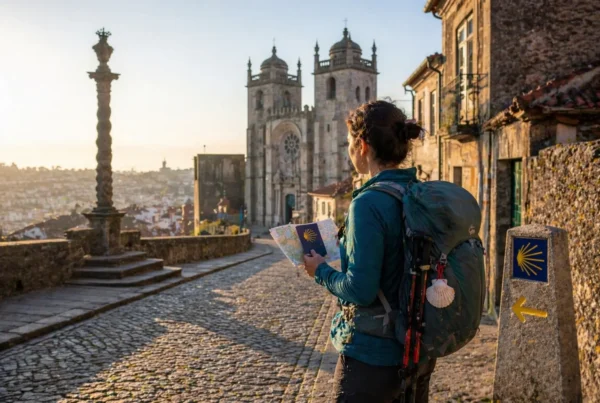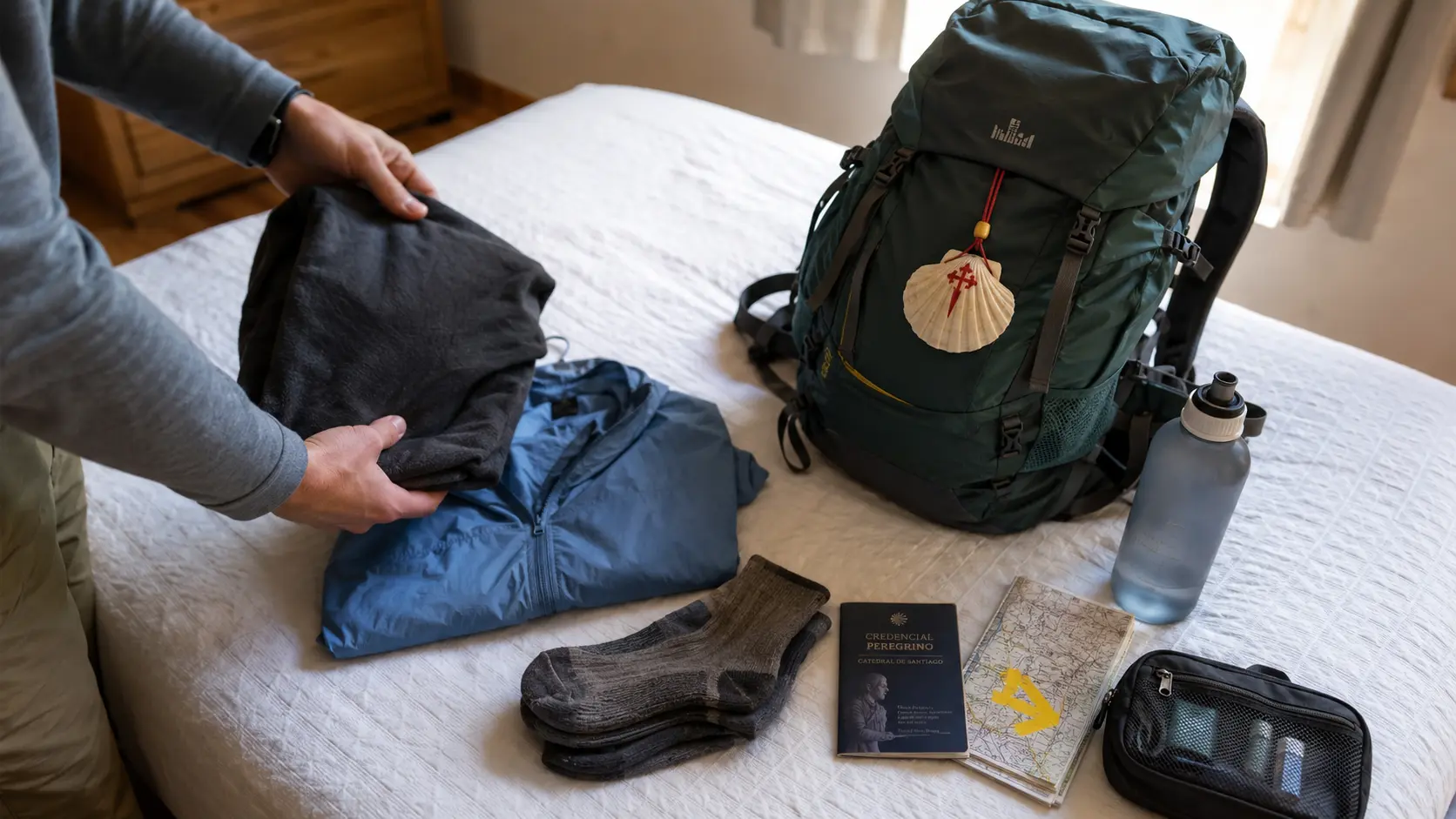
Most Portuguese Coastal Camino packing mistakes come from trying to solve uncertainty with extra gear. That feels sensible before departure, but after several long walking days from Porto towards Galicia, every duplicated layer, heavy toiletry bottle and unused backup item becomes part of the walk.
This guide is not another full packing list. The goal is to help you avoid the decisions that usually create discomfort: carrying too much, choosing footwear too late, packing for the wrong weather, assuming laundry will always dry overnight, or treating baggage transfer as a reason to bring everything.
If you need the item by item version after reading this, use our Camino packing list for the Portuguese Way as the next step.
Key takeaways
- Pack for repeatable daily comfort, not for every possible situation you can imagine before leaving home.
- Your footwear choice matters less than fit, testing and how your feet react after several hours of walking.
- A light rain layer, sun protection and fast drying clothes are usually more useful than extra outfits.
- Baggage transfer can make the walk easier, but it does not remove the need for a sensible daypack.
- The best packing decision is often subtraction: fewer items, better tested, with less duplication.
Mistake 1: packing for every possible Camino instead of your Camino
First time pilgrims often pack as if the Camino is a wilderness expedition, a city break, a beach holiday and a mountain trek at the same time.
The Portuguese Coastal Camino needs a more practical approach. You are preparing for repeated walking days, mixed surfaces, exposed coastal weather, towns, accommodation changes and simple daily routines. You are not packing for every rare scenario.
The better question is not “could I use this?” The better question is “will I use this often enough to justify carrying it every day?”
That test removes a lot of weight. It usually cuts extra outfits, spare shoes, heavy toiletries, backup gadgets, large towels, bulky books and clothing that only works in one narrow condition.
Mistake 2: carrying too much because each item feels small
Overpacking rarely happens because of one ridiculous item. It happens because many small “just in case” items survive the packing process.
A spare shirt seems harmless. A second warm layer seems sensible. A large power bank, full size shampoo, extra sandals, heavy rain poncho and backup trousers all feel reasonable in isolation. Together, they change the walk.
The practical rule: pack the bag, then remove weight before you leave. Do not wait for your knees, shoulders or feet to make the decision on day three.
A rough backpack weight rule can help, but do not treat any percentage as universal. Your body size, fitness, injury history, route pace, footwear, accommodation style and use of baggage transfer all matter. A better test is simple: can you walk for one to two hours with the packed bag and still feel stable, balanced and comfortable?
If the answer is no, the bag is too heavy for your current plan.
Mistake 3: choosing a backpack that invites overpacking
A large backpack creates permission to fill it. That is the problem.
For many pilgrims carrying their own gear, a smaller walking backpack with good fit is more useful than a large trekking pack designed for camping. The Portuguese Coastal Camino does not normally require a tent, cooking kit or several days of food. If your pack is built for that kind of trip, it may encourage you to bring more than you need.
Fit matters as much as volume. A backpack that sits badly on your hips or pulls on your shoulders can feel fine in the shop and irritating after hours of walking.
Before buying or committing to a pack, read our guide to the best backpack for the Portuguese Camino. Use it to think about size, fit, access, rain protection and whether you are carrying everything or using baggage transfer.
Mistake 4: buying footwear too late
The biggest footwear mistake is not choosing trail runners instead of boots, or boots instead of trail runners. The bigger mistake is choosing any footwear too late.
Your shoes or boots need to be tested before the Camino. Not for ten minutes at home. Not only on a flat pavement near your house. Test them on longer walks, with the socks you plan to wear, and with the bag or daypack you expect to carry.
Trail runners or low cut hiking shoes can work well for many pilgrims who prefer lighter footwear and are carrying a light pack. Hiking boots can make sense if you want more structure, ankle coverage, durability or support under a heavier load. There is no single best choice for everyone.
What matters most is fit. Your toes need room, your heel should not slide badly, and you should not feel pressure points that you hope will disappear later. Hope is not a footwear strategy.
Mistake 5: ignoring socks and foot care
Some pilgrims spend weeks choosing shoes and five minutes choosing socks. That is backward.
Socks affect moisture, friction and comfort. Cotton socks are usually a poor choice for repeated long walking days because they dry slowly and hold moisture. Hiking socks or technical walking socks are a better starting point.
Carry enough socks to rotate properly. If one pair gets wet or does not dry overnight, you do not want to start the next day with damp fabric against tired feet.
A small foot care kit is sensible. Keep it simple: blister plasters or pads, tape that you already know works for your skin, and a way to deal with hot spots early. Do not wait for a small rub to become a full blister before you act.
This is not medical advice. If a blister looks infected, becomes unusually painful, or does not improve, get appropriate medical help.
Mistake 6: packing for only one weather story
The Portuguese Coastal Camino can tempt people into packing for a single weather idea: sunny coast, rainy Galicia, cool Atlantic wind, or hot summer walking.
Any one of those can be true on a given day. The mistake is treating one of them as the whole story.
A better approach is light layering. Bring clothes that can combine in different ways: a breathable walking top, a light warm layer, a rain shell, and sun protection. That gives you more flexibility than packing many complete outfits.
A heavy coat is usually less useful than a lighter system you can adjust through the day. The same logic applies to rain gear. You need protection, but you also need to avoid overheating inside a non breathable layer while walking.
Mistake 7: assuming laundry will dry overnight
Laundry is part of Camino packing. The mistake is assuming it will always be easy.
Some nights, clothes dry quickly. Other nights, the room is humid, the weather is wet, the heating is limited, or you arrive too late to wash and dry everything properly.
Pack with one simple buffer: you should be able to walk the next day even if yesterday’s clothes are still damp.
That usually means enough underwear and socks for rotation, plus fast drying fabrics. It does not mean packing a clean full outfit for every day.
Mistake 8: bringing optional gear without a clear reason
Optional gear becomes a problem when it is packed from anxiety rather than purpose.
Walking poles are a good example. They can help some pilgrims with rhythm, balance, descents, tired legs or confidence. They are less useful if you dislike using them, never practise with them, or only pack them because other pilgrims mention them online.
If you are unsure, read our guide to Camino walking sticks before deciding. Also check airline and airport rules before assuming poles can travel in cabin luggage.
The same logic applies to extra shoes, camera gear, tablets, travel pillows, large first aid kits and multiple bags. If the item does not solve a clear daily problem, question it.
Mistake 9: treating baggage transfer as permission to overpack
Baggage transfer can be useful, especially if carrying a full backpack would make the Camino less comfortable or less realistic for you.
But it does not make packing irrelevant.
You still need to manage your daypack. You still need essentials with you while walking. You still need to confirm accommodation details, collection rules, delivery windows and bag limits with the provider before paying.
The practical mistake is sending a heavy suitcase ahead and then walking with a daypack that is also too full. That creates two problems instead of one.
If you are considering this option, read our guide to baggage transfer from Porto on the Portuguese Coastal Camino. Use it to understand the planning sequence before you build your packing strategy around luggage delivery.
Mistake 10: trying to save money by packing the wrong gear
Cheap gear is not automatically bad. Expensive gear is not automatically better. The mistake is buying something because it is cheap, then replacing it during the Camino because it does not work.
Footwear is the clearest example. Poor fit can become expensive if it forces you to buy emergency replacements. The same applies to a painful backpack, slow drying clothes, weak rain gear or socks that create friction.
Spend where failure would hurt your walk: footwear, socks, backpack fit and rain protection. Save where the stakes are lower: simple toiletries, basic sleepwear, laundry soap, non technical accessories and duplicate clothing you can avoid entirely.
Packing choices also affect your total trip cost. If you use luggage transfer, replace gear on route, or book private rooms to make laundry easier, those decisions add up. For the wider money picture, see our Portuguese Coastal Camino budget tips.
Packing mistake decision table
| Mistake | Likely effect | Better decision | What to check before leaving |
|---|---|---|---|
| Packing too many “just in case” items | Extra weight every day | Keep only items with regular use or clear value | Walk with the packed bag before departure |
| Choosing footwear too late | Blisters, pressure points or sore feet | Test shoes or boots on long walks | Use the same socks and pack weight you expect on the Camino |
| Ignoring wet or windy days | Cold, damp or uncomfortable walking | Use a light layering system | Rain shell, warm layer and sun protection |
| Assuming laundry always dries overnight | Damp clothes the next morning | Pack fast drying clothing and sock rotation | Enough clean essentials for one imperfect laundry night |
| Using baggage transfer to justify a large suitcase | More logistics and possible provider issues | Pack lighter even if sending luggage ahead | Provider limits, accommodation rules and daypack essentials |
| Bringing optional gear without testing it | Unused weight or awkward walking | Practise with poles, rain gear and backpack setup first | Whether the item helps your actual walking style |
What not to pack for the Camino without a strong reason
This is not a universal ban list. Some pilgrims will have personal needs. But for most first time pilgrims, these items deserve extra scrutiny:
- Jeans or other slow drying heavy trousers.
- Multiple “nice” outfits for evenings.
- Large bottles of shampoo, conditioner or shower gel.
- Heavy cotton towels.
- Several books or a large tablet if your phone already covers the need.
- Extra shoes that are not clearly needed for walking or shower use.
- Bulky coats that cannot be layered well.
- Duplicate chargers, cables and gadgets.
- Large first aid kits full of items you do not know how to use.
The useful test is frequency. If you might use something once, but will carry it for two weeks, it needs to justify itself.
Before you close your bag: a practical checklist
- Pack everything you plan to take.
- Walk with the full bag or daypack for at least one longer local walk.
- Notice where you feel pressure: shoulders, hips, lower back, feet or knees.
- Remove at least one item from each category: clothing, toiletries, electronics and backup items.
- Check whether every clothing item dries quickly enough for repeated use.
- Test your footwear with the socks you will actually wear.
- Prepare a small foot care kit and keep it accessible.
- Decide whether you are carrying everything or using baggage transfer before you finalise your bag.
- Keep passport, money, phone, medication, rain layer and valuables in your daypack.
- Use the full packing list only after you have removed the obvious excess.
FAQ
How heavy should my backpack be on the Portuguese Coastal Camino?
There is no perfect number for every pilgrim. The safer principle is to keep it as light as you reasonably can while still carrying your real essentials. If the packed bag feels uncomfortable after one or two hours of walking at home, it is too heavy for your current setup.
Are trail runners enough for the Portuguese Coastal Camino?
They can be enough for many pilgrims, especially with a light pack and tested fit. Hiking shoes or boots may be a better fit if you want more structure, ankle coverage, durability or support. Do not choose based on category alone. Choose based on fit, terrain, weather, load and your own feet.
Should I pack waterproof shoes?
Waterproof footwear can help in wet conditions, but it can also feel warmer and less breathable. Fast drying non waterproof footwear can suit some pilgrims better. The mistake is not choosing one or the other. The mistake is choosing without testing how your feet react over several hours.
Can I rely on buying missing items along the route?
You may be able to replace basic items in towns, but do not build your plan around emergency shopping. Critical fit items, especially footwear, socks and backpack comfort, are better solved before departure.
Do I need walking poles?
No, not every pilgrim needs them. They are useful if they improve your balance, rhythm or comfort, but they are not essential for everyone. Test them before the Camino rather than discovering your preference on the first stage.
Your next step
Before buying more gear, do one subtraction round. Remove the items you are carrying for anxiety rather than daily use.
Then check the essentials against the Camino packing list for the Portuguese Way. The right order matters: first avoid the common mistakes, then complete the list.